

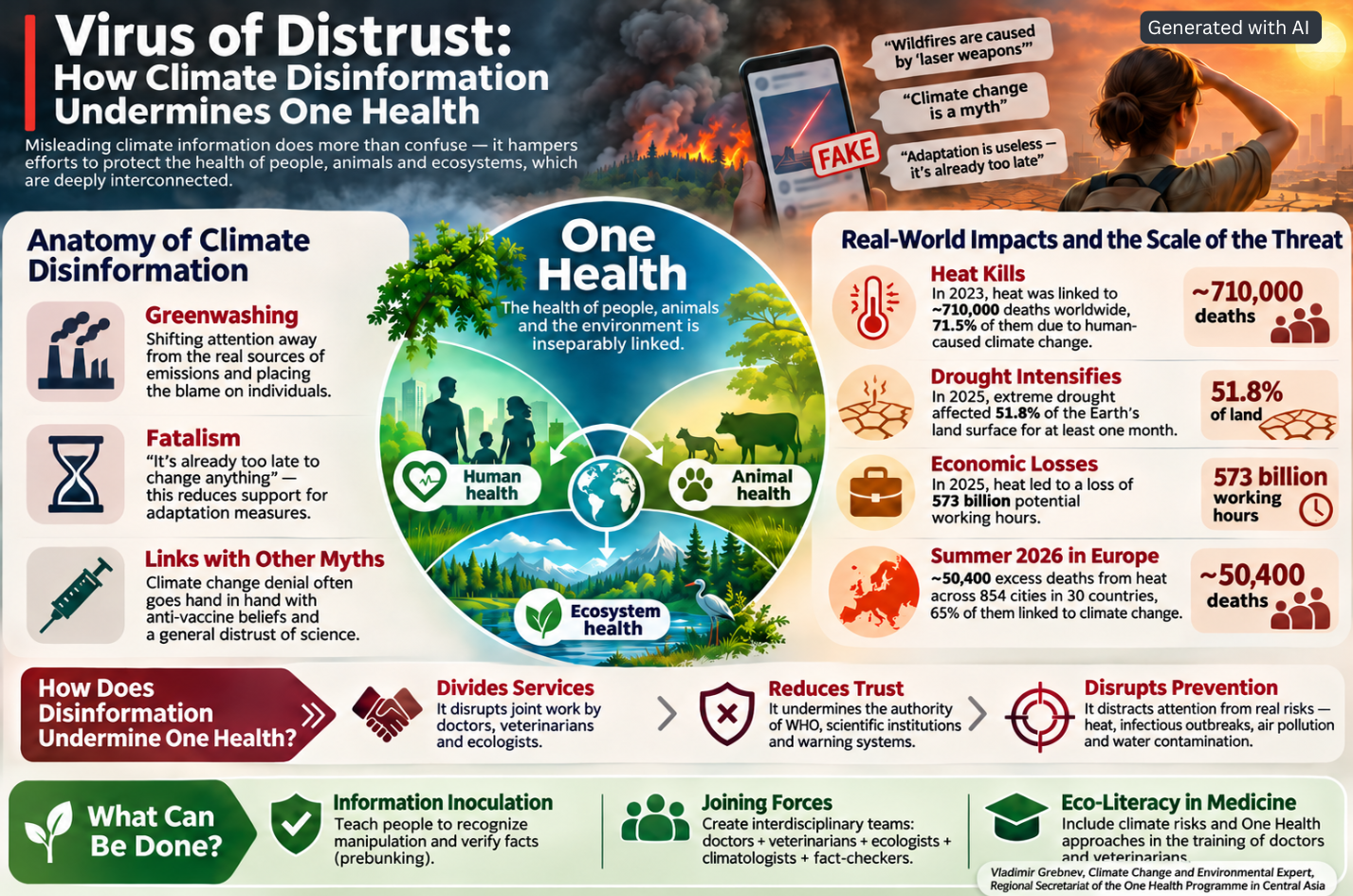
In the summer of 2023, devastating wildfires in Canada turned a national disaster into an international health threat. Yet, alongside warnings about hazardous air pollution, social media was flooded with stories about “laser weapons,” deliberate arson and various conspiracies. Rather than focusing on the health impacts of smoke and the protective measures people needed to take, part of the public debate shifted towards searching for imaginary culprits. This case illustrates one of the dangers of climate disinformation: it can divert attention from the information people need to protect their health and the ecosystems around them.
Researchers from Canada, the United States and China subsequently assessed the scale of the actual threat using satellite observations and computer modelling. They found that approximately 354 million people in North America and Europe were exposed to fine particulate matter (PM₂.₅) pollution associated with the Canadian wildfires. Their estimates suggest that prolonged exposure to the smoke may have contributed to 82,100 premature deaths worldwide, including 64,300 in North America and Europe.
The lesson is clear: accurate, timely information is as important to protecting people as medical care and environmental monitoring systems.
Climate disinformation is increasingly viewed not merely as a problem of information accuracy, but as a distinct public health risk that can weaken prevention and adaptation to climate change. In the report “Protecting Health in the Age of Climate Disinformation,” the Global Climate and Health Alliance (GCHA) and the WHO Civil Society Working Group on Climate Change and Health called for climate disinformation to be recognised as a public health threat and for responses to it to become part of risk prevention and management systems. The report identifies three interconnected pathways of harm: direct harm, when misleading information prevents people from responding promptly to extreme heat, wildfires, floods and other hazards; systemic harm, when the manipulation of facts delays action to reduce pollution, adapt to climate change and strengthen health systems; and institutional harm, when confidence in scientists, medical professionals and public institutions is eroded, weakening prevention and cross-sector cooperation. The Lancet Countdown 2026 report also includes a dedicated analysis of disinformation, noting a shift from outright denial of climate change towards delaying action, greenwashing, discrediting experts and promoting a false sense that effective solutions are impossible.
One Health is based on a simple idea: the health of people, domestic and wild animals, plants and ecosystems is interconnected. It is not just a collection of separate government programmes, but a way to prevent risks together. Think of it as a system of communicating vessels: if environmental monitoring detects water contamination, veterinary services observe unusual disease patterns in animals, and physicians record a rise in infections, what matters is not only the quality of each observation, but also how quickly these signals are brought together into a shared picture.
Climate change affects temperatures and water regimes, the condition of rangelands and habitats, the seasonality of disease vectors, and interactions among wildlife, livestock and people. Not every increase in infectious disease can automatically be attributed to warming: pathogen transmission also depends on land use, sanitation, migration, biological factors and the quality of surveillance. This is precisely why One Health calls for joint assessments rather than competing explanations based on isolated pieces of information.
Disinformation can be particularly damaging here. When a climate warning is dismissed as “fabrication,” reports of livestock deaths as “veterinary panic,” and water test results as “unfounded environmental fears,” three vital connections are disrupted: between scientific evidence and public behaviour, between the responsible services, and between evidence and investment in prevention.
The consequences of climate change are no longer a matter of projections: they can already be measured in lives lost, economic damage and growing pressure on health systems. According to the Lancet Countdown 2026, exposure to heat was associated with approximately 710,000 deaths worldwide in 2023, and researchers attributed 71.5% of this burden to human-induced climate change. In 2025, extreme drought affected 51.8% of the world’s land area for at least one month, while heat led to the loss of 573 billion potential working hours. Yet only 56 of the WHO’s 194 Member States reported having a national health adaptation plan for climate change [3].
The summer of 2026 offered another alarming demonstration of the scale of the threat. According to a study published in Nature Health, heat caused an estimated 50,400 additional deaths between June and August in 854 cities across 30 European countries. Researchers attributed approximately 32,600 of these deaths (65%) directly to human-induced climate change. This was more than 70% higher than the estimated heat-related mortality in the same cities during the summer of 2022.
The economic consequences were equally significant. According to Allianz Research, extreme heat in the summer of 2026 resulted in an estimated €113 billion in lost economic output across 30 European countries, equivalent to 0.46% of their combined GDP. A broader estimate by Triodos Bank suggested possible losses to the EU economy of up to €180 billion, or around 1% of GDP, accounting for reduced labour productivity and damage to agriculture, energy and transport. Climate change is thus already causing measurable harm to health and economies. The danger of disinformation lies in downplaying genuine threats and undermining confidence in scientific evidence and warnings, potentially delaying protective action precisely when every week can matter for people’s health and lives.
In 2025, the land-temperature anomaly in the statistical subregion of Central Asia reached +3.1°C relative to 1951–1980, compared with +1.9°C for the world’s land areas as a whole. For Kazakhstan, key concerns include heat, drought, steppe fires and urban smog; for Kyrgyzstan and Tajikistan, glacier conditions, floods, mudflows, drinking water and mountain pastures; and for Turkmenistan and Uzbekistan, water scarcity, drought and windblown dust. These differences shape cross-border zoonotic disease surveillance and environmental risk management, but do not establish any difference in the prevalence of climate disinformation.
Air pollution provides a particularly clear example of the price of misinterpreting evidence. According to a regional World Bank study, exposure to outdoor PM₂.₅ pollution was associated with more than 65,000 premature deaths in Central Asia in 2021 and annual health-related economic losses of US$15–21 billion. In cities, soil and desert dust account for roughly 20–50% of PM₂.₅ exposure, while the remaining 50–80% comes from human activities. The claim that “all air pollution here is natural, so nothing can be done” is therefore incorrect.
In March 2026, Uzbekistan’s national environmental authority used atmospheric monitoring data to rebut claims that “acid clouds” were allegedly approaching from Iran. This real-world example demonstrates the value of prompt, clear and verifiable explanations when misleading environmental information circulates.
The Lancet Countdown 2026 makes a compelling case that climate-related health hazards are growing faster than adaptation efforts and that climate information is not always translated into services tailored to health-sector needs. For Central Asia, the strategic lesson is that climate data should no longer be treated as merely background information for disease surveillance. Integrating climate data into One Health can help identify where and when joint monitoring of people, animals and ecosystems is most needed, and which preventive measures should be launched in advance.
The goal should not be to “win arguments online,” but to make reliable information part of the regional early-warning system. In practice, this means coordinated messages from hydrometeorological services, environmental agencies, medical and veterinary authorities; regular publication of air and water quality data, laboratory findings and the evidence behind warnings; accessible information in national languages and Russian; and training for doctors, veterinarians, journalists and local leaders in risk communication.
“Information vaccination,” or prebunking, is also important: people can be taught in advance to recognise familiar manipulation tactics, such as fake experts, selective quotation, conspiracy theories and the false choice between health and the economy. At the same time, responses to disinformation must remain open to good-faith criticism, independent verification of evidence and transparency about conflicts of interest. The more clearly the limitations of a study and the costs of a proposed measure for farmers or households are explained, the less room there is to exploit people’s fears.
The FAO–UNEP–WHO–WOAH One Health Joint Plan of Action, extended in 2026 through 2029, provides a framework for coordinated action by medical, veterinary and environmental services. At the same time, safeguarding the integrity of climate information has already become part of the international climate agenda: at the UNFCCC COP30 in Brazil in 2025, a Declaration on Information Integrity on Climate Change was presented and endorsed by a number of countries. These issues are expected to receive further attention at the forthcoming UNFCCC COP31 in Türkiye (9–20 November 2026), where One Health is part of the conference programme and international discussions are planned on tackling climate disinformation and strengthening trust in scientific evidence. WHO has also highlighted implementation of the Belém Health Action Plan and the new Antalya Initiative for Health Resilience as part of COP31. For Central Asia, this creates further opportunities to deepen regional cooperation, link climate monitoring with early-warning systems for infectious diseases and environmental threats, and improve public communication. Ultimately, the effectiveness of One Health depends not only on the quality of research and coordination among specialists, but also on public trust in reliable information: without that trust, even the most accurate scientific evidence may never lead to practical action.
One Health begins not only with laboratories and regulatory documents, but also with trust in a common body of evidence. If environmental experts identify a climate warning sign but veterinarians, physicians and the public do not trust it, the system loses precious time. Information resilience must become as essential to One Health as disease surveillance, early warning and the fight against antimicrobial resistance.
Vladimir Grebnev, Climate Change and Environmental Expert, Regional Secretariat of the One Health Program in Central Asia, cc_specialist@carececo.org
This publication was developed by the Regional Environmental Centre for Central Asia (CAREC) within the framework of the regional "One Health" program in Central Asia. The program is implemented with financial support from the World Bank and the Pandemic Fund. The author bears sole responsibility for the content of this publication. The views expressed do not necessarily reflect the official position of the World Bank or the Pandemic Fund.
For further information:
Oxana Kravtsova — Regional Program Coordinator, "One Health" Program, CAREC, okravtsova@carececo.org