
The Regional One Health Action Plan, or ROHAP, is a working document of the Regional One Health Secretariat, which operates under the Regional Environmental Centre for Central Asia (CAREC).
It is important to understand that ROHAP is not a national plan nor a substitute for national strategies. It is a work plan of the regional coordination structure, focusing on cross-border and cross-sectoral interaction. The document covers areas such as coordination of actions between states and agencies, harmonization of approaches to addressing common challenges, conducting joint exercises, organizing data exchange, and training specialists at the regional level.
The Plan has a framework nature. This means it is not rigid or fixed: it allows for annual additions and revisions based on proposals received from participating countries.
What is the current status of the document?
ROHAP has already been developed by the Secretariat team. During its preparation, bilateral meetings and consultations were held with representatives of relevant ministries from all five Central Asian countries, as well as regional discussions. The comments and feedback received have been collected and systematized.
The document is currently in its final stage-the official approval process within the competent authorities of each country. This involves the ministries and committees responsible for health, agriculture (veterinary services), food safety, and environmental protection.
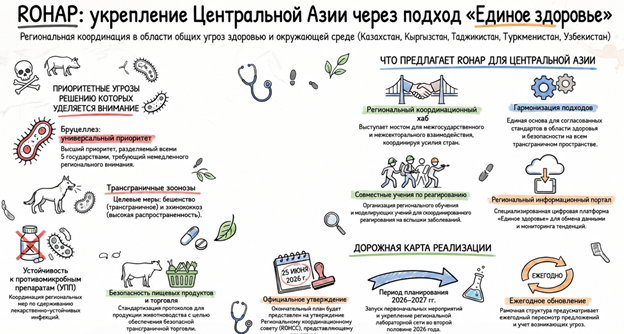
Final approval of ROHAP is scheduled for June 25, 2026. It is expected to take place during a meeting of the Regional One Health Coordination Council (ROHCC), with all five Central Asian states represented.
Which priority threats will be included in the final version?
When identifying priorities, the Secretariat relied on data provided by the participating countries themselves. The following list of threats has emerged and will be reflected in the final version of the Plan.
Brucellosis holds a special place-it has been identified as a common priority for all five countries in the region. Other priority zoonoses include rabies, which has a pronounced cross-border nature and poses a serious challenge to both veterinary and public health systems, as well as echinococcosis, which creates a significant medical and social burden in the region.
Beyond specific diseases, ROHAP also addresses broader topics. These include antimicrobial resistance (AMR) , which requires coordinated cross-country control measures, and food safety particularly in the context of cross-border trade in livestock products, where harmonized standards and approaches are of critical importance.
What other areas does the Plan cover?
In addition to addressing the threats listed above, ROHAP structures the Secretariat’s activities across ten key areas. These include establishing and maintaining regional coordination mechanisms, developing the One Health information portal, strengthening the regional laboratory network, organizing training, conducting joint outbreak response simulation exercises, monitoring and evaluating effectiveness, and working to align policies and legal frameworks across countries.
Key characteristics of the document
The scope of ROHAP is limited to regional interaction, and it does not interfere with the mandate of national governments. The document has a framework structure, allowing its content to be updated annually based on new proposals from countries. The current planning horizon covers 2026–2027, with subsequent annual adjustments.
The immediate practical step following its approval on June 25, 2026, will be the launch of activities planned for the second half of 2026.