
Central Asia Climate Change Conference: The Evolution of a Regional Platform from Expert Dialogue to an Architecture for Joint Action
Context and Institutional Challenge
Central Asia is a region highly vulnerable to the impacts of climate change. Climate risks here possess a critical transboundary dimension, directly affecting water use, energy systems, land degradation, food security, and long-term social stability.
In the early stages of regional interaction, environmental challenges were discussed in isolation at the national level, or irregularly and unsystematically at the regional level. Primary attention was directed toward recording risks and accessing data. The region lacked a practical tool capable of translating the declarative global commitments of countries under their Nationally Determined Contributions (NDCs) and National Adaptation Plans (NAPs) into coordinated actions. There was an urgent need to establish a unified, regular, and facilitated mechanism capable of combining the efforts of government agencies, scientists, businesses, development partners, and civil society to exchange information, experience, and results in order to develop coordinated responses to climate threats and jointly mobilize climate finance.
Solution: Creating a Regular Regional Dialogue Platform
To overcome the fragmentation of national initiatives, a large-scale effort was launched to develop the Central Asia Climate Change Conference (CACCC). The platform systematically evolved as an inclusive space, expanding the scope of discussed topics by consolidating the efforts of countries and development partners, while broadening the circle of participants by engaging the academic community, youth, businesses, and the media.
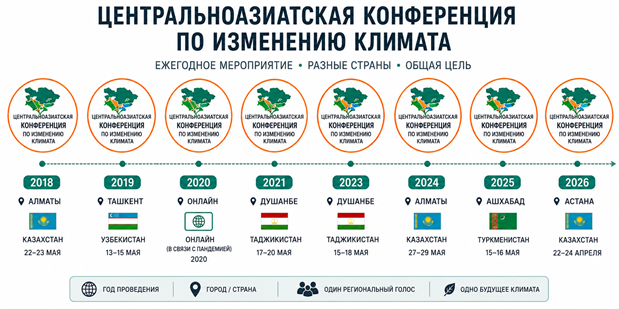
Timeline and geographical coverage of the Central Asia Climate Change Conference.
Having overcome the challenges of the pandemic period and proven its institutional resilience in an online format, the conference returned to in-person operations with a practical agenda. The platform outgrew the format of an isolated standalone event and became an integral part of prestigious regional high-level platforms, such as the Environmental Summit 2026 and the Global Mountain Forum 2027. Thanks to this integration, climate policy in the region is no longer viewed in isolation, but as a strategic component of state sustainable development plans, budget planning, and national investment policies.
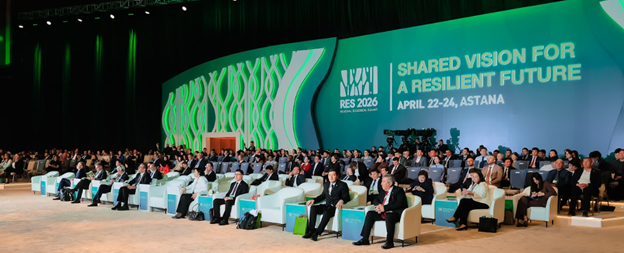
Photo 1. Opening plenary session of CACCC-2026 at the RES 2026 platform.
Results: Transition to Practical Implementation and Financing
Today, the conference serves as the main driver of climate leadership in Central Asia, enabling a large-scale transition from the stage of declarative goal-setting to the stage of practical implementation. Bringing together over ten thousand participants on a single platform, including a record twenty-five percent representing the private sector and business, the platform achieved measurable results across key sectors of the climate agenda:
- Synchronization of Commitments and Action Plans: The conference became the first major regional platform following the global COP30 summit, allowing countries to promptly ground international agreements within the Central Asian context. The focus centered on developing practical pathways to implement updated Nationally Determined Contributions (NDCs 3.0), National Adaptation Plans, and decarbonization strategies.
- Transboundary Landscape Restoration: Within the framework of the World Bank’s regional program, a shift toward large-scale practical actions on vulnerable lands was secured. The main achievements included the official signing of multilateral agreements, the launch of the "Green Shield" Initiative by all five regional governments, and the launch of a practical project for pilot forest landscape restoration.
- Regional Action on Methane Reduction: The topic of emission reduction was elevated from a narrow technical field to a priority economic policy. Regional countries coordinated steps to transition from baseline calculations to verified Measurement, Reporting, and Verification (MRV) systems utilizing satellite data. Following the sessions, plans were announced to jointly develop a Regional Joint Statement on Methane Emission Reduction.
- Activation of Climate Finance: As part of the flagship track featuring the region's leading commercial banks, a shift from donor aid to market mechanisms was recorded. Key outcomes included the signing of a multilateral Memorandum of Understanding between regional think tanks to jointly study carbon markets, the presentation of a "single window" National Green Finance Mechanism, and the development of pilot green bond issuances and risk-mitigation instruments to mobilize private capital.
- Economic Dimension of Water-Energy Cooperation: A crucial practical outcome was the signing of an agreement between the Executive Committee of the International Fund for Saving the Aral Sea (EC IFAS) and the World Bank’s Central Asia Water-Energy Program (CAWEP) to prepare a new large-scale regional project, consolidating the transition to hybrid economic models for joint resource management.
- Capacity Building and Science Development: The shortage of specialists in the field of renewable energy sources (RES) received a practical solution through the signing of four memorandums of cooperation between key technical universities of the region, including the Energy Institute of Tajikistan, the Kyrgyz State Technical University named after I. Razzakov, Satbayev University of Kazakhstan, the Central Asian University of Environmental and Climate Change Studies of Uzbekistan, and CAREC to launch unified educational courses on climate and green energy.
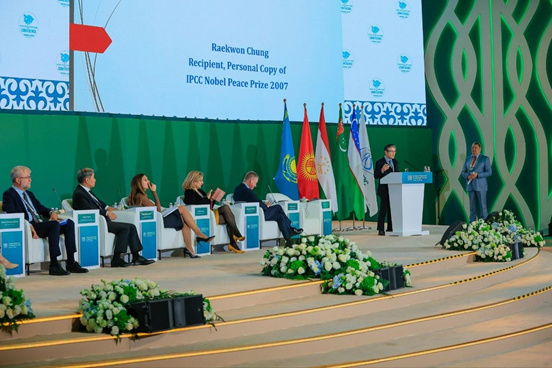
Photo 2. Keynote address by Nobel Peace Prize Laureate Rae Kwon Chung at the closing session of CACCC-2026 (RES 2026 platform).
Regional Synergy of the Rio Conventions and Institutional Success
A special part of CAREC's success story has been the demonstration of real transboundary solidarity and the creation of a platform for the coordinated implementation of the three UN Rio Conventions. CACCC helped overcome an isolated approach by unifying the agendas on climate (UNFCCC), biodiversity conservation (CBD), and desertification (UNCCD) into a single architecture of action. A practical example of this synergy was the launch of the "Green Shield" Initiative and transboundary landscape restoration projects, which simultaneously reduce climate risks and prevent land degradation.
The high level of regional diplomacy is also demonstrated by the financing model: while the RESILAND project in Tajikistan acted as a strategic donor, the events were consistently hosted by Turkmenistan and Kazakhstan, with Kyrgyzstan set to take over next. In 2026, the RESILAND project in Uzbekistan joined the funding. Significantly, despite the core funding coming from Tajikistan, these crucial milestones were hosted by other states in the region: the platform was rolled out in Turkmenistan, then in Kazakhstan, and Kyrgyzstan will host the next edition.
This approach was made possible through rounds of negotiations successfully conducted by CAREC with the countries, national project implementation units, and members of the Regional Coordination Committee. Achieving a consensus at such a high level locked in the readiness of Central Asian countries to invest in shared regional interests, transforming the conference into a truly independent, rotating, and unifying interstate platform.
At the same time, the next qualitative step and a genuine testament to CACIK's institutional maturity should be a gradual transition from international donor support to a co-financing sustained by the national budgets of the participating countries, ensuring the absolute long-term sustainability of the platform.
Sustainability and Long-Term Impact
The conference has successfully transformed from a predominantly advisory forum into a regular platform for expert exchange and knowledge sharing. It ensures the formulation of a unified regional position on global stages and facilitates joint investment attraction into the region. By laying the foundation for coordinating the actions of Central Asian countries ahead of COP summits, the platform makes a vital contribution to strengthening environmental security and sustainable development in the region.
Author:
Lyudmila Kiktenko, Environmental Management Programme Manager, Regional Environmental Centre for Central Asia (CAREC)
Our contacts for CACCC inquiries:
Dilovarsho Dustzoda, Advisor to the CAREC Executive Director — ddustzoda@carececo.org
Azamat Kauazov, Climate Change and Sustainable Energy Programme Manager — cacip@carececo.org