

The scale of the problem
Central Asia is a “blind spot” in global antimicrobial resistance (AMR) surveillance: data are scarce, while antibiotic consumption in the region remains high. In 2019, bacterial AMR was associated with 4.95 million deaths worldwide, 1.27 million of which were directly attributable to it [1]; by 2050, 1.91 million attributable and 8.22 million associated deaths per year are projected [3].
The consequences are also visible in hospitals: according to studies from post-Soviet countries, 70–80% of isolated bacteria were multidrug-resistant, meaning they did not respond to several classes of antibiotics at once [4]. The main driver of AMR is the inappropriate use of antibiotics [2], and this problem is particularly pressing for Central Asia.
Consumption will not decline on its own
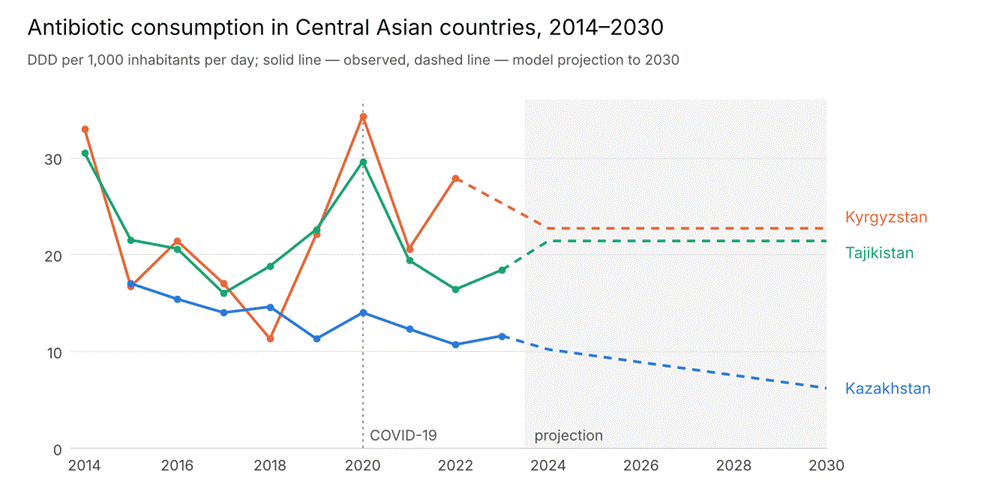
Semenova et al., Antibiotics 2025 (WHO Regional Office for Europe AMC Network data) · observed 2014–2023, projected 2024–2030
In 2022–2023, countries of the region consumed between 10.7 and 27.9 DDD (defined daily doses) per 1,000 inhabitants per day [2]. In 2020, consumption rose sharply in all countries, partly because azithromycin was mistakenly believed to have antiviral activity and was used inappropriately for COVID-19. Projections show that, without additional measures, consumption in most countries will not decline substantially by 2030 [2].
Why this happens
One of the main reasons is that antibiotics can still be bought without a prescription, even though the law prohibits it [2]. According to a WHO Regional Office for Europe survey, 21% to 37% of respondents had obtained antibiotics from a pharmacy without a prescription [2]. Such access sustains self-medication [2], while demand is fuelled by the widespread misconception that antibiotics help with more illnesses than they actually do [3].
Doctors are under pressure too: in a survey of 1,231 general practitioners in Central Asia, patient demand for antibiotics was the second most common reason for inappropriate prescribing (22.8% of responses) [3]. Doctors themselves lack time and knowledge: lack of time is the most common reason they do not discuss resistance with patients (43.2% of responses), and 27.1% of doctors are unfamiliar with the delayed antibiotic prescribing strategy [3].
Practical recommendations
The most practical action is to ensure that prescription-only dispensing of antibiotics is enforced in practice, not just on paper. This requires regular pharmacy inspections, stricter penalties for violations and monitoring of antibiotic sales [1, 2], as well as information campaigns on the risks of self-medication [2]. Doctors are also ready to support these measures: 94.4% of them need additional information resources, and 85.1% would like more evidence-based clinical guidelines [3]. Vaccination also helps reduce the need for antibiotics: in Kyrgyzstan, for example, higher measles vaccination coverage was associated with lower antibiotic consumption [2]. Consistent implementation of these measures will reduce inappropriate antibiotic use among the population — one of the main drivers of antimicrobial resistance.
Nadezhda Ryapolova
Public Health Specialist “One Health” Program, Regional Environmental Centre for Central Asia (CAREC)
For further information:
Oksana Kravtsova – Regional "One Health" Program Coordinator, CAREC, okravtsova@carececo.org
References
1. Lim L. et al. Optimizing antibiotic stewardship and reducing antimicrobial resistance in Central Asia: A study protocol for evidence-based practice and policy. PLoS ONE, 2025. doi: 10.1371/journal.pone.0307784
2. Semenova Y. et al. Social Determinants of Health and Antibiotic Consumption. Antibiotics, 2025. doi: 10.3390/antibiotics14050513
3. Semenova Y. et al. Antibiotic Resistance Awareness and Prescribing Behavior Among General Practitioners in Kazakhstan, Kyrgyzstan, Uzbekistan, and Tajikistan. Antibiotics, 2026. doi: 10.3390/antibiotics15030309
Zhazykhbayeva D. et al. Antimicrobial Resistance Surveillance in Post-Soviet Countries: A Systematic Review. Antibiotics, 2024. doi: 10.3390/antibiotics13121129