

Dear readers,
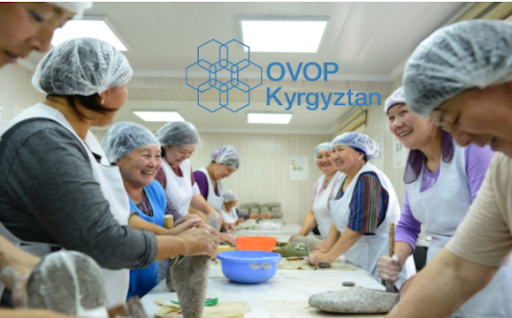
In this issue, we continue our special series on the practical application of the One Village One Product (ОVOP) approach in Kyrgyzstan and across Central Asia. Previously, we explored the origins and
philosophy of the OVOP movement. Now, we turn our focus on Kyrgyzstan, a story of adaptation, structured development, and, importantly, women’s economic empowerment.
The ОVOP concept began to be implemented in the Kyrgyz Republic in 2007 with the support of the Japan International Cooperation Agency (JICA). Rather than simply replicating the Japanese experience, the model was gradually adapted to Kyrgyzstan’s socio-economic and geographic realities.
As one of the world’s most mountainous countries with 94% of its territory covered by mountains and an average altitude of 2,750 meters, Kyrgyzstan faces structural constraints: dispersed rural populations, limited arable land, logistical challenges, and seasonal production cycles. The first stage of implementation therefore focused on building foundations. Communities were trained in basic production organization, cost calculation, quality management, and understanding market requirements. Importantly, the program did not rely on direct subsidies or equipment distribution. This approach strengthened ownership and responsibility among participating groups and laid the groundwork for long-term sustainability.
A key milestone occurred in 2011 with the establishment of the One Village One Product Association in the Issyk-Kul region. This marked the transition from a donor-supported pilot to a structured organizational system. During this period, the Kyrgyz OVOP model took on a distinct institutional shape. A clear division of roles was introduced between production groups, responsible for manufacturing and quality control, and business support structures (ОVOP+1), responsible for marketing, branding, logistics, and financial management. This separation reduced operational and financial risks for producers, ensured consistent quality standards, and enabled coordinated promotion of products in domestic and international markets.
In the following years, ОVOP expanded geographically and institutionally. Regional brand committees were formed, certification and self-quality control mechanisms were introduced, production workshops were strengthened, and sales channels were developed in both domestic and foreign markets. The Kyrgyz ОVOP model is distinguished by its reliance on small-scale processing, the separation of production and business functions, structured capacity building, and a sustained focus on quality as the basis for market confidence and stable income generation.
Another defining feature of the Kyrgyz model has been its strong gender dimension. From the outset, women played a central role in production groups. In many rural communities, women already possessed traditional skills in felt-making, food processing, herbal remedies, and handicrafts. ОVOP created a structured framework that transformed these skills into organized, market-oriented economic activity. Women-led production groups became some of the most stable and quality-focused participants within this system. Their strong involvement in production consistency, peer-based quality control, and collective organization contributed significantly to the credibility and growth of the OVOP brand.
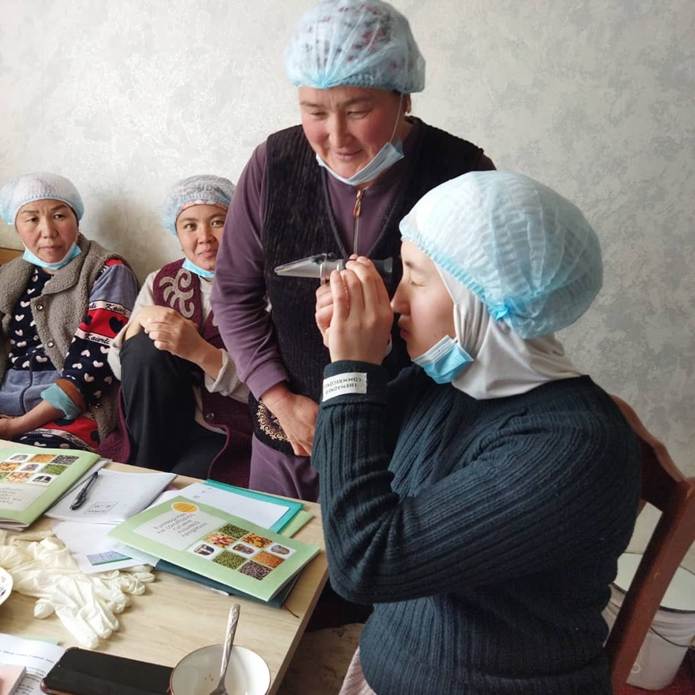
Photo: OVOP producers measure sugar content in berries for quality control during jam production.
Today, ОVOP has created more than 3,300 rural jobs, with approximately 95 percent held by women. This has translated into more stable household incomes, greater financial autonomy, and stronger participation of women in community decision-making. Because ОVOP activities generate direct and measurable income, women’s economic contributions become more visible within household financial planning. Flexible production formats, including home-based and cooperative models have allowed women to combine income-generating activities with family responsibilities. In doing so, ОVOP has strengthened both household resilience and local economic stability. Women are not only participants in the system; they increasingly serve as group coordinators, trainers, and representatives in regional brand structures.
Beyond income generation, women’s participation in OVOP has had important intergenerational effects. Increased and more predictable earnings allow households to invest in children. In rural contexts where economic vulnerability can drive outward migration, diversified income streams generated through women’s entrepreneurship contribute to greater family cohesion and long-term community stability.
Comparative experiences from other countries further underscore this dimension. In Kenya, for example, ОVOP-related initiatives have demonstrated that participation in structured, value-added production can enhance women’s entrepreneurial confidence and strengthen group-level management practices. While social and economic contexts differ, these cases suggest that when women engage in organized production systems linked to market access and quality standards, tangible financial outcomes can reinforce both business discipline and economic agency. The Kyrgyz experience reflects similar dynamics: by transforming traditional knowledge into market-recognized products, OVOP has expanded women’s economic participation while contributing to broader rural development and resilience.’
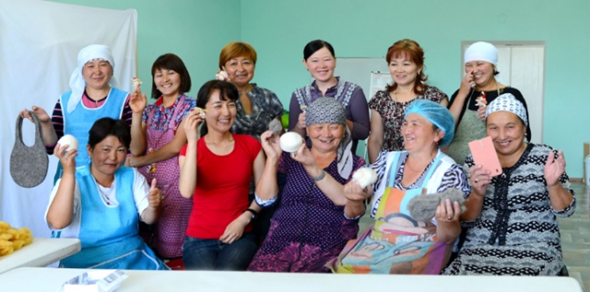
At the first-ever “Central Asia plus Japan” Dialogue Summit held in Tokyo in December 2025, OVOP products from Kyrgyzstan were showcased at an official exhibition, including white honey and wool felt goods made from local resources. For many rural women producers, this is their first time seeing their work/crafts presented on an international stage. Today, with more than 3,000 registered producers and exports reaching countries such as Japan, the United States, France, and Norway, women-led and women-dominated production groups are contributing to global markets. Since ОVOP production can be carried out locally, it also offers an alternative to labor migration, allowing women to earn income while remaining within their communities. In this way, ОVOP shows how small-scale, locally rooted enterprises can open global opportunities while strengthening families and preserving traditional knowledge.
In upcoming publications, we will examine:
● “Kyrgyz Felt in Tokyo: Cooperation with MUJI”
— how rural producers entered global retail markets and met international quality standards;
Stay informed through our series for further case studies, practical insights, and expert perspectives. Subscribe to the ОСОП Kyrgyzstan YouTube channel and follow the blog of Japan International Cooperation Agency (JICA) for in-depth information and exclusive content.
#ОСОП #RESILANDCA #KGRESILAND #Kyrgyzstan #WorldBank #REC #OneVillageOneProduct #NatureBasedSolutions #NBS #CentralAsia