

Central Asian countries have committed to restoring over 2.5 million hectares of degraded land under the Bonn Challenge, a global initiative to restore 350 million hectares of degraded and deforested land worldwide by 2030. Uzbekistan aims to restore 500,000 hectares of degraded land by that time, and the Uzbekistan Resilient Landscape Restoration Project (RESILAND Uzbekistan) is part of the country’s efforts to combat desertification and land degradation.
RESILAND Uzbekistan focuses on restoring degraded landscapes, promoting sustainable forest management, and strengthening the resilience of landscapes to climate change.
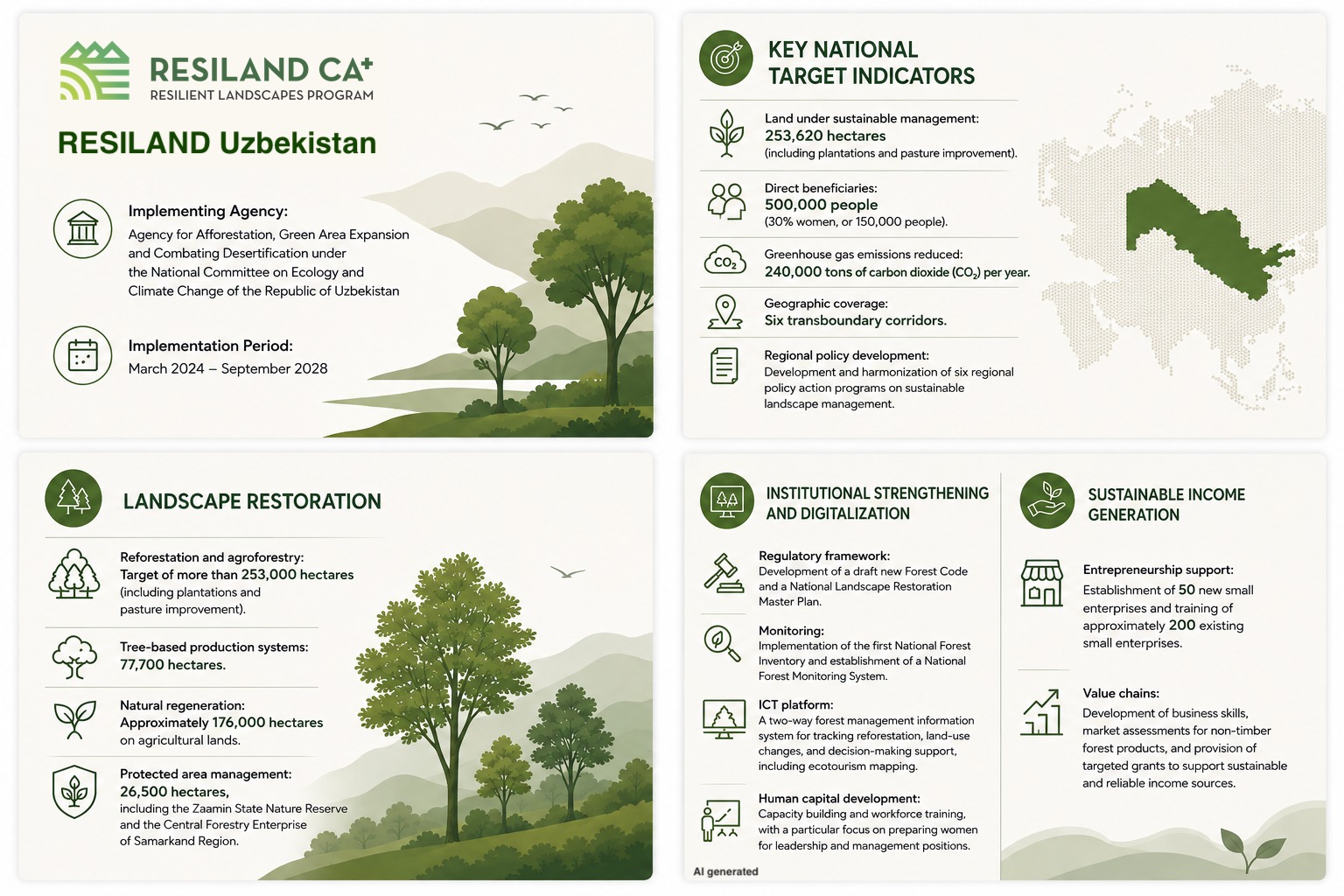
The project also supports regional cooperation among Central Asian countries. In addition, RESILAND Uzbekistan is developing modern forest monitoring systems and digital tools for natural resource management.
Another important area of the project is creating alternative sources of income for local communities and supporting local entrepreneurship.
--------------------------------------
The Uzbekistan Resilient Landscape Restoration Project (RESILAND Uzbekistan) is part of the World Bank’s RESILAND CA+ program, aimed at strengthening landscape resilience across Central Asian countries.
RESILAND Uzbekistan is implemented by the Agency for Increasing Forests and Green Areas and Combating Desertification under the National Committee on Ecology and Climate Change of the Republic of Uzbekistan, with financial support from the World Bank, PROGREEN, and KWPF.
Contact information:
Asferachew Abate – Senior Environmental Specialist, The World Bank
Dildora Aralova – Environmental safety specialist, the Agency for Afforestation, Expansion of Green Areas, and Combating Desertification under the Ministry of Ecology, Environmental Protection, and Climate Change of the Republic of Uzbekistan
Azamat Kauazov – Deputy Team Leader of Uzbekistan Resilient Landscape Restoration project: regional component, CAREC