
Karakol sits at the eastern end of Issyk-Kul, surrounded by some of the most biodiverse mountain terrain in Central Asia. Its valleys are rich in wild herbs, its pastures produce high-quality wool, and its  hillsides yield sea buckthorn and barberry. For generations, much of this abundance was sold raw. That is beginning to change.
Nazgul Omuralieva works as a regional coordinator in Karakol, supporting communities through the OVOP (One Village One Product) programme. She gives her vantage point from on the ground, in the communities themselves on what sustainable rural development actually looks like when it works.
The most consequential shift Nazgul Omuralieva describes is not about products at all. It is about agency. In most development programmes, communities receive training, inputs, market connections, and funding. Within the OVOP model, communities are invited to lead.
"Local communities become a driving force for change when they are given the opportunity to make their own decisions and develop their own ideas. People stop being mere participants and begin acting as initiators — coming together, drawing on their own resources, and creating products rooted in local knowledge and traditions. This is precisely what builds sustainability — projects continue to live and grow at the community level." — Nazgul Omuralieva, Regional Coordinator, Karakol
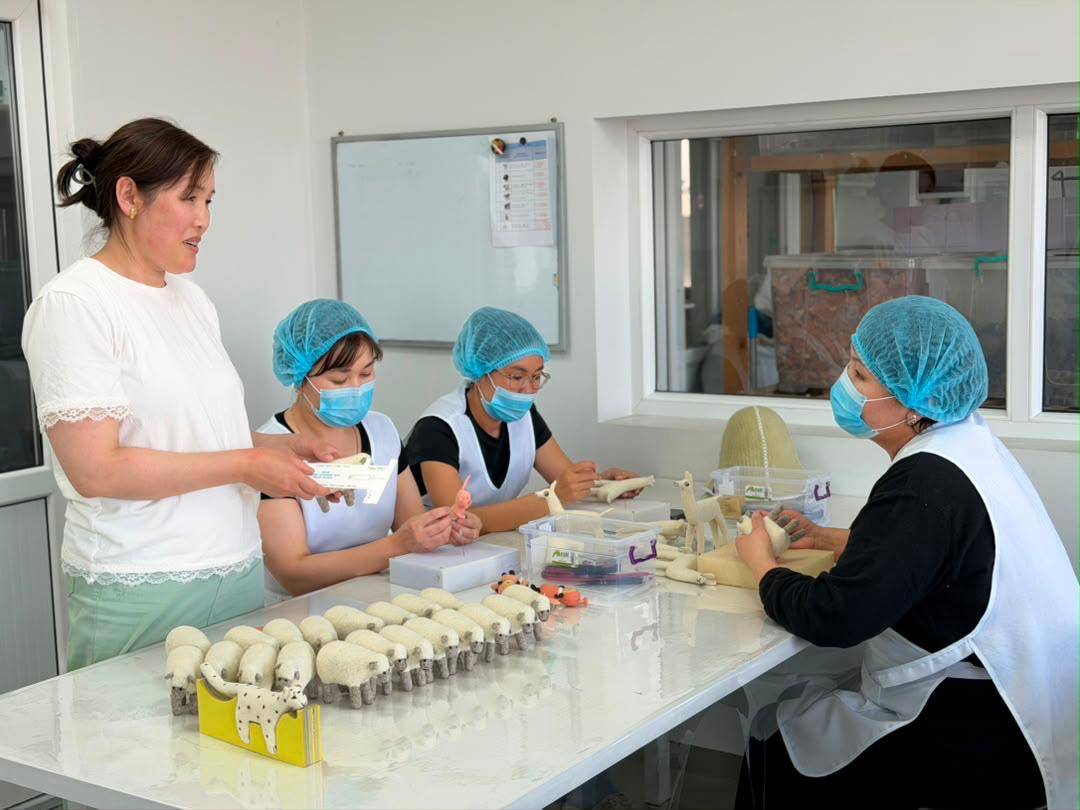
It is the community setting the direction. Across the communities Nazgul Omuralieva works with, one of the most visible transformations is in how raw materials are handled. The same resources that once left villages in bulk, unprocessed, and undervalued are now being turned into finished goods with intentional quality, considered packaging, and a growing brand identity.
"Participants begin extracting greater value from the same raw materials and gradually move toward a more sustainable income model. Local raw materials begin to 'open up' through processing and transform into fully realized products." — Nazgul Omuralieva
Communities don't need the market to shift in their favor or wait for outside conditions to improve. By processing what they already have, they increase what they earn from it, and the value comes from the work itself.
One of the most distinctive aspects of Nazgul Omuralieva's account is how she describes the relationship between OVOP and environmental responsibility. In many development contexts, "sustainability" is appended to projects as a qualifier, as something to include in the reporting.
"Environmental responsibility is built into OVOP projects from the outset — through the use of local resources. Natural materials are used, traditional techniques are preserved, and waste is minimized. This not only reduces the environmental footprint but also makes the products more valuable to consumers, especially given growing demand for natural and eco-friendly goods." — Nazgul Omuralieva
But the same features that make production environmentally sound — natural dyes, minimal waste, traditional craft techniques — are also the features that differentiate these products in global markets. In this model, ecology and commerce point in the same direction. In remote mountain communities where electricity can be unreliable and capital is scarce, the most relevant solutions are often the most accessible ones.
"Solar dryers for fruits and berries improve product quality and reduce dependence on electricity. Compact, energy-efficient equipment suited to rural conditions makes it possible to produce goods on-site without significant costs. These solutions make production more sustainable, economical, and accessible for remote communities." — Nazgul Omuralieva
.jpeg)
Solar drying is a good example of what might be called appropriate technology: it uses an abundant local resource (sunlight) to solve a real production problem (preservation and shelf life) without requiring infrastructure that doesn't exist. The result is that communities can process and sell what they grow, rather than watching it spoil or selling it at a loss to intermediaries before harvest season ends.
Perhaps the most distinctive element of Karakol's OVOP work is its engagement with wild-harvested plants that grow naturally across the mountain slopes of the Issyk-Kul region, which have been used by local communities for centuries. The question is whether they can be made into a viable income stream without being depleted in the process.
"When approached responsibly, wild harvesting becomes an additional source of income for rural residents, particularly in mountain areas. The emphasis is on sustainable harvesting — without depleting resources and with the natural balance preserved. This allows communities to simultaneously protect biodiversity and create distinctive products with strong market value." — Nazgul Omuralieva
This balance between use and preservation is one of the central challenges of any nature-based economy. What Nazgul Omuralieva describes is a model in which the discipline of sustainable harvesting is not imposed as a regulation, but understood from within as a condition of the community's own long-term wellbeing. The incentive for stewardship is built in.
What emerges from Nazgul Omuralieva's account is not a single programme or initiative, but a coherent philosophy of rural development. It is one that is assembled from several interlocking elements that reinforce each other. None of these elements works well in isolation. Community ownership without market orientation leads to products nobody buys. Market orientation without ecological grounding depletes the resource base. Simple technology without community buy-in goes unused. It is the combination that creates something durable.
In the mountains around Karakol, that combination is being tested in real time to reshape what it means to make a living from a landscape. The results are not dramatic in the way that infrastructure projects or large-scale investment announcements tend to be. But they are the kind of results that persist because they belong to the people who made them.
Nazgul Omuralieva serves as a regional coordinator for the OVOP programme in Karakol, Kyrgyzstan, supporting rural communities in developing locally-rooted products, adopting sustainable production practices, and building toward market-oriented livelihoods.
# OVOP #RESILANDCA #KGRESILAND #Kyrgyzstan #WorldBank #REC #OneVillageOneProduct #NatureBasedSolutions #NBS #CentralAsia