

Antalya – Turkey – 10 November 2026 – A thematic event entitled “Experience of CBIT Projects and Opportunities for Regional Cooperation in Central Asia on Climate Transparency” was held at the Turkmenistan Pavilion during COP31.
Representatives of Turkmenistan, Uzbekistan and Tajikistan, the Food and Agriculture Organization of the United Nations (FAO), the Regional Environmental Centre for Central Asia (CAREC) and the United Nations Environment Programme (UNEP) discussed the experience of implementing national CBIT projects aimed at strengthening climate data and reporting systems, as well as institutional capacity. Particular attention was given to the common challenges facing Central Asian countries under the enhanced transparency framework of the Paris Agreement.
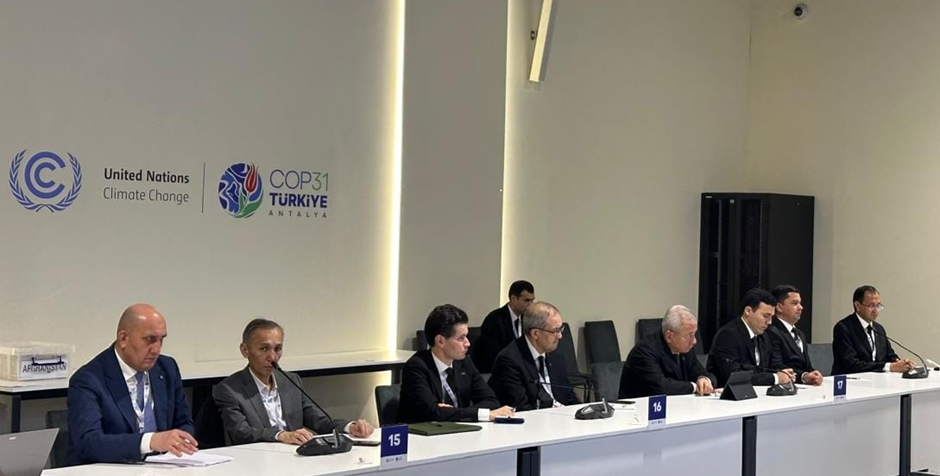
The event was organized by the Ministry of Environmental Protection of Turkmenistan and the Scientific Information Center of the Interstate Commission for Water Coordination of Central Asia under the International Fund for Saving the Aral Sea (SIC ICWC IFAS), with the support of FAO.
During the event, participants presented the practical results of national projects and discussed technical and methodological needs, interagency coordination and specialist training.

The opportunities for regional cooperation under the ReCATH and CBIT-GSP initiatives were also explored, including the exchange of methodologies, joint training and peer review. The panel discussion helped identify common needs across the region and consider practical areas for further cooperation on climate transparency.
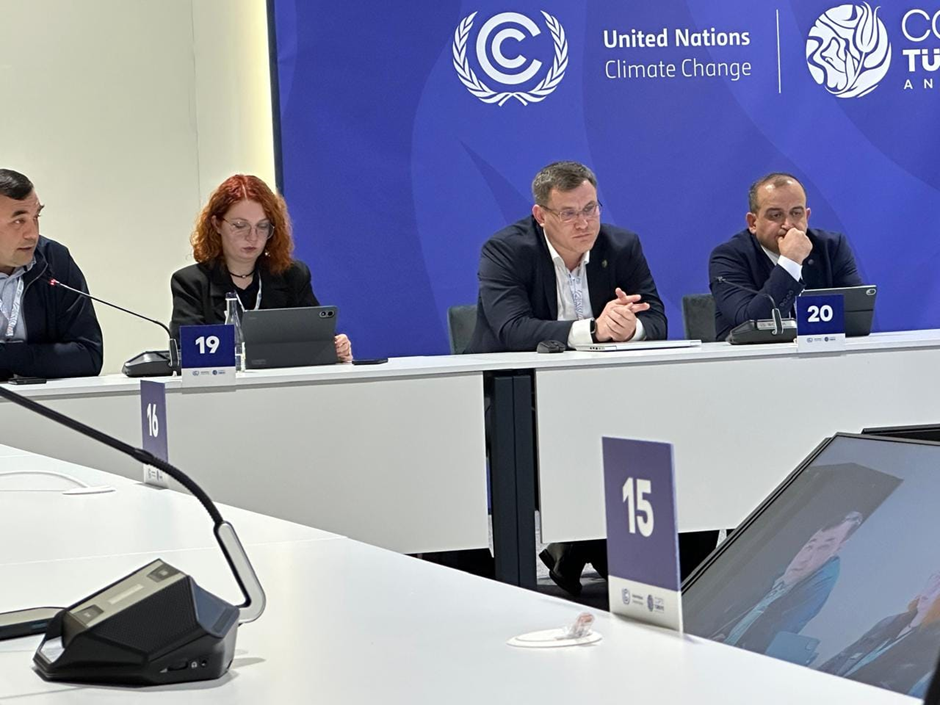
In his remarks during the session entitled “Approaches to Identifying and Addressing Climate Transparency Needs in Central Asia and the Caucasus: Examples of Engagement with Regional Partners and Results of Joint Training, Methodological Exchange and Peer Review,” Dilovarsho Dustzoda, Advisor to the CAREC Executive Director, highlighted the practical importance of the event for all Central Asian countries and expressed his appreciation to the Ministry of Environmental Protection of Turkmenistan, SIC ICWC IFAS and FAO. The full text of his speech is presented below.
Speech by Dilovarsho Dustzoda, Advisor to the CAREC Executive Director
For many years, the Regional Environmental Centre for Central Asia (CAREC) has supported countries across the region in meeting their international climate commitments. One of the important instruments in this work is the Regional Climate Action Transparency Hub for Central Asia (ReCATH), established in 2021 with the support of the Initiative for Climate Action Transparency (ICAT).
Over the past five years, ReCATH has evolved into a regional platform bringing together national experts, government institutions and international technical partners to address climate transparency challenges collectively.
Our experience shows that many of the technical challenges faced by countries are similar in nature and can be addressed more effectively through regional cooperation.
These include improving the quality of national greenhouse gas inventories, refining calculation methodologies, developing adaptation monitoring systems, tracking progress in the implementation of Nationally Determined Contributions (NDCs), and preparing reports in accordance with the enhanced transparency framework of the Paris Agreement.
Through ReCATH, we seek to translate regional cooperation into practical action.
For example, in 2025, we organized regional practical training on the peer review of national greenhouse gas inventories. Representatives from all five Central Asian countries worked with specific methodologies and review tools, exchanged experience and discussed common technical challenges.
As a result of this work, a methodology for the peer review of greenhouse gas inventories was developed. Countries can use it to improve the quality of their national reporting and prepare for international technical review processes.
Another important area of work relates to the land use, land-use change and forestry sector. Our activities in this area include practical training on the application of IPCC software, improving methodological approaches, and assessing the impact of sectoral policies and measures.
We also pay particular attention to the preparation of Biennial Transparency Reports (BTRs). Within the framework of ReCATH, technical discussions and regional events have been held to identify practical challenges in reporting and determine countries' needs for additional support.
At the same time, we recognize that countries are at different stages of developing their national transparency systems. It is therefore particularly important that regional support responds to specific national needs rather than being limited to general training activities.
I would also like to highlight the expansion of ReCATH's thematic portfolio.
Today, our work extends beyond climate reporting to include methane emission reduction.
With the support of the Global Methane Hub (GMH) and the Environmental Defense Fund (EDF), CAREC is implementing regional initiatives aimed at strengthening countries' capacities in methane emissions monitoring, reporting and management.
This work includes improving methodological approaches to emissions assessment, strengthening the technical capacities of specialists, sharing international experience and developing practical solutions for reducing emissions.
Importantly, cooperation in this area extends beyond the five Central Asian countries. Azerbaijan and Mongolia participate as observers in the regional methane initiative.
We see this as an opportunity to expand professional exchange and share successful technical solutions among countries facing similar challenges.
Thus, ReCATH is gradually evolving from a platform supporting climate reporting into a broader mechanism for regional technical cooperation, linking transparency with practical action to reduce emissions.
Looking ahead, I would like to highlight two priority areas for our work in 2027–2029.
The first priority is improving the quality of national greenhouse gas inventories.
We plan to continue supporting countries in improving emissions estimates, applying IPCC methodologies, developing peer review mechanisms and preparing national experts for international technical review.
The second priority is supporting the implementation and tracking of national NDCs, including NDC 3.0.
In this area, particular importance is attached to improving data collection systems, developing progress indicators, assessing the results of climate measures and strengthening interagency coordination.
In conclusion, I would like to emphasize that regional cooperation is most effective when it helps countries address specific technical challenges and directly contributes to strengthening their national climate transparency systems.
This is precisely the approach we seek to advance through ReCATH, together with our national partners, ICAT, CBIT-GSP, FAO, GMH, EDF and other international organizations.
Additional information:
Dilovarsho Dustzoda
ReCATH Project Manager recath_manager@carececo.org