

For Kazakhstan, the restoration of degraded landscapes, combating desertification, biodiversity conservation, and enhancing ecosystem resilience are issues of particular importance. This was stated by Bakdaulet Amangeldinov, Chief Expert of the Department of Reproduction and Use of Forests and Flora, Forestry and Wildlife Committee Ministry of Ecology, Geology and Natural Resources of the Republic of Kazakhstan, during the Regional Dialogue on Restoring Sustainable Landscapes in Central Asia held in Bishkek.
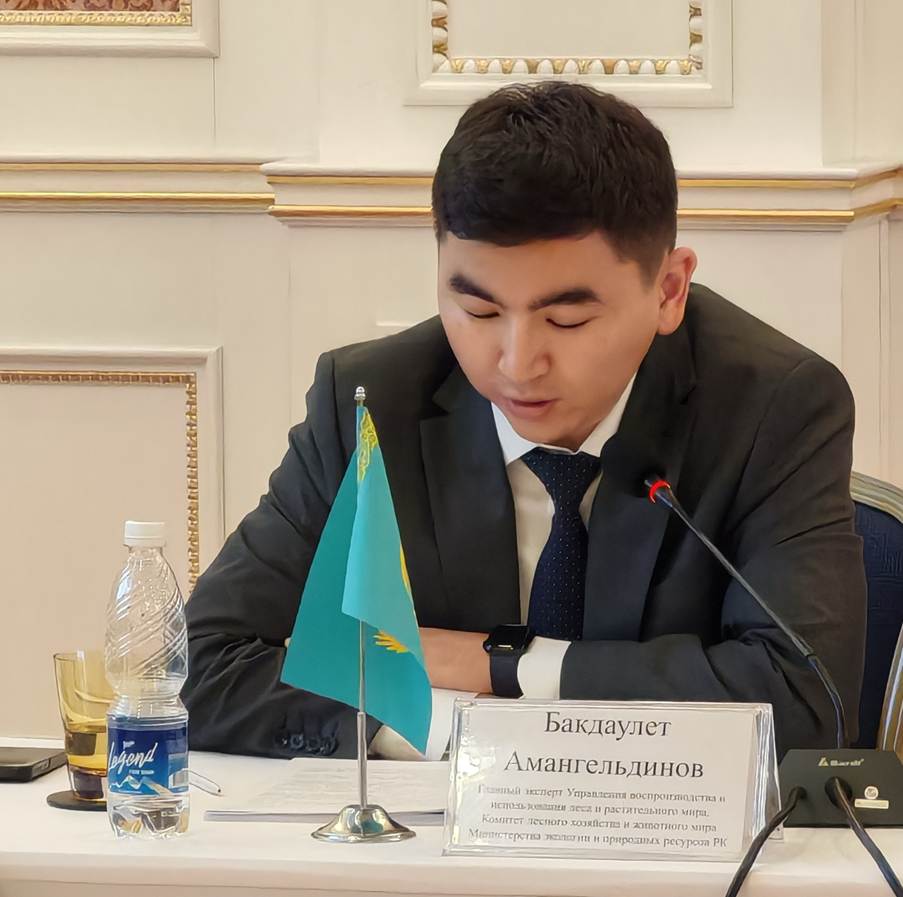
He noted that forest conservation and restoration are one of the key priorities of the Concept for the Conservation and Sustainable Use of Biological Diversity for 2026–2035, adopted last year.
According to the expert, the area of Kazakhstan’s State Forest Fund amounts to 31.4 million hectares, of which 14 million hectares are forested. The country’s forest cover stands at 5.1 percent. Mountain forests account for approximately 6 million hectares. By 2030, Kazakhstan plans to increase its forested area to 14.5 million hectares. In addition, approximately 2 billion tree seedlings are planned to be planted on lands within the State Forest Fund.
Bakdaulet Amangeldinov emphasized that a significant share of these plantings is being carried out on degraded and desert lands in the southern regions of Kazakhstan. This is directly linked to efforts aimed at landscape restoration, combating desertification, and strengthening ecosystem resilience.
“Kazakhstan is also implementing a comprehensive set of measures to combat desertification in rural areas. This work includes forest reclamation, pasture restoration, the introduction of water-saving technologies, conservation agriculture, and the sustainable use of natural resources,” the expert stated.
As noted by the expert, in this context the RESILAND CA+ Program serves as an important platform for experience sharing among Central Asian countries. Kazakhstan possesses practical experience that can contribute to the regional agenda of RESILAND CA+, including afforestation and forest reclamation activities on the dried bed of the Aral Sea, establishment of forest plantations on degraded lands, development of saxaul nurseries, introduction of closed-root planting stock, and expansion of specially protected natural areas.
“At the same time, Kazakhstan is interested in further strengthening cooperation with Central Asian countries, international partners, the World Bank, and other organizations to restore degraded landscapes and enhance the climate resilience of the region,” said Bakdaulet Amangeldinov.
Bakdaulet Amangeldinov also noted that during the session ‘The Green Shield of Central Asia: A Regional System of Protective Forest Belts’ at the Regional Ecological Summit in Astana, Kazakhstan, Kyrgyzstan, Tajikistan, and Uzbekistan signed a resolution on the establishment of a regional system of protective forest belts and the restoration of forest landscapes to combat desertification, land degradation, and the impacts of climate change.
According to the expert, the resolution provides for the development of national afforestation programs, identification of suitable areas, establishment of protective forest plantations by 2035, as well as the strengthening of regional cooperation, mobilization of international financing, and introduction of a monitoring mechanism for implementation.
“It is expected that the implementation of these approaches will reduce the impacts of dust and sand storms, decrease soil erosion, improve environmental conditions, and strengthen the resilience of the economies of Central Asian countries. In this regard, the ‘Green Shield of Central Asia’ initiative logically complements the objectives of the RESILAND CA+ Program and provides an additional foundation for expanding interstate cooperation, ensuring sustainable financing for forest reclamation activities, and engaging the private sector in ecosystem restoration projects across the region,” Bakdaulet Amangeldinov concluded.
By Zhanna Khusainova, Media Consultant, CAREC, pr@carececo.org
---------------------------
About the RESILAND CA+ Program
The Central Asia Resilient Landscapes Restoration Program (RESILAND CA+) is financed by the World Bank with support from the the Global Partnership for Sustainable and Resilient Landscapes (PROGREEN) and the Korea‑World Bank Partnership Facility (KWPF).
The Program brings together the RESILAND Kyrgyzstan, RESILAND Tajikistan, and RESILAND Uzbekistan projects, while promoting regional cooperation among the countries of Central Asia in sustainable landscape management, climate change adaptation, and disaster risk reduction.
The Regional Environmental Centre for Central Asia (CAREC) implements the regional component of the RESILAND projects in the Kyrgyz Republic, Tajikistan, and Uzbekistan.
Additional information:
Lyudmila Kiktenko – Deputy Team Leader, “The Kyrgyz Republic Resilient Landscape Restoration Project: Regional Component” Project, CAREC, lkiktenko@carececo.org
Dilovarsho Dustzoda — Deputy Team Leader of the Project Implementation Group for “Sustainable Landscape Restoration in the Republic of Tajikistan: Regional Component”, CAREC, ddustzoda@carececo.org
Azamat Kauazov – Deputy Team Leader of Uzbekistan Resilient Landscape Restoration project: regional component, CAREC, cacip@carececo.org