

Bangkok – Thailand – 27 October 2025 — At the Panel Intervention on Data and Transparency in the Climate–Material Nexus, Dilovarsho Dustzoda, Advisor to the CAREC Executive Director, highlighted how reliable data can move beyond simple reporting to become a driver of genuine transformation in climate and economic policy.
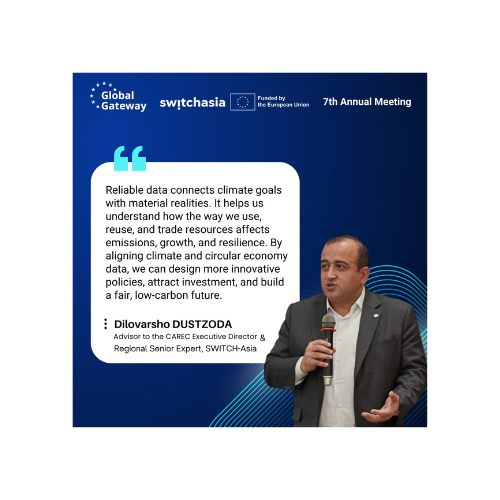
“Reliable data connects climate goals with material realities,” Dilovarsho Dustzoda said. “It helps us understand how the way we use, reuse, and trade resources affects emissions, growth, and resilience. By aligning climate and circular economy data, we can design more innovative policies, attract investment, and build a fair, low-carbon future.”
Dilovarsho Dustzoda, Advisor to the Executive Director of the Regional Environmental Centre for Central Asia (CAREC)
Across Central Asia, countries are strengthening their data systems to better link climate action with material efficiency. In Kazakhstan, the Green Economy Concept is now supported by data on resource efficiency and waste management, while Kyrgyzstan and Tajikistan are advancing pilot initiatives on recycling and waste through the SWITCH-Asia Programme. These steps, though early, are laying the groundwork for more integrated and evidence-based climate planning.
The private sector is also emerging as an important player in this transformation. Companies in industries such as textiles, cement, and metals are increasingly measuring and reporting their resource use and emissions, helping governments develop better policies and sectoral targets.
Dilovarsho Dustzoda also noted the influence of the European Union’s Carbon Border Adjustment Mechanism (CBAM), which requires detailed emissions data for materials like cement, steel, and aluminum.
“CBAM is not only a trade policy—it’s a data transformation catalyst. Good data is becoming a passport for trade and investment,” he said.
Concluding the panel, Dilovarsho Dustzoda emphasized the role of SWITCH-Asia in fostering collaboration between governments, industries, and development partners to harmonize data systems and make them consistent, credible, and useful for both policy and investment.
“Ultimately, data is the bridge between ambition and action—between policy and progress,” Dilovarsho Dustzoda concluded.
Contact information:
Dilovarsho Dustzoda – Advisor to the Executive Director, CAREC, ddustzoda@carececo.org