
.jpeg)
The Global One Health Movement and Its Flagship Platform
The World One Health Congress (WOHC) is the premier international platform bringing together researchers, practitioners, policymakers, international organizations, and civil society to address the interconnected health of humans, animals, and ecosystems.
The Congress is organized by the Global One Health Community, formerly known as the One Health Platform, which was founded in 2015 during the 3rd International Congress in Amsterdam. In 2022, the organization broadened its vision and rebranded to promote inclusive, comprehensive engagement across the global movement.
The overarching goal of WOHC is to advance a multisectoral and transdisciplinary approach to improving the health and well-being of people, animals, and the environment. In line with the mission of the Global One Health Community, the Congress addresses the following core objectives:
-
· Fostering scientific research on zoonotic and vector-borne infectious diseases;
-
· Building synergies and facilitating data sharing among researchers;
-
· Disseminating scientific discoveries and translating evidence for broader audiences;
-
· Capacity building and nurturing the next generation of One Health experts;
-
· Fostering the science-to-policy dialogue;
-
· Advocating for the One Health approach globally.
The Congress focuses on critical global threats, including (re-)emerging viruses, antimicrobial resistance (AMR), bacterial and parasitic infections, and the vital need for cross-sectoral cooperation amid growing cross-border mobility of humans, animals, food, and feed.
A History Across Eight Congresses: From Melbourne to Cape Town
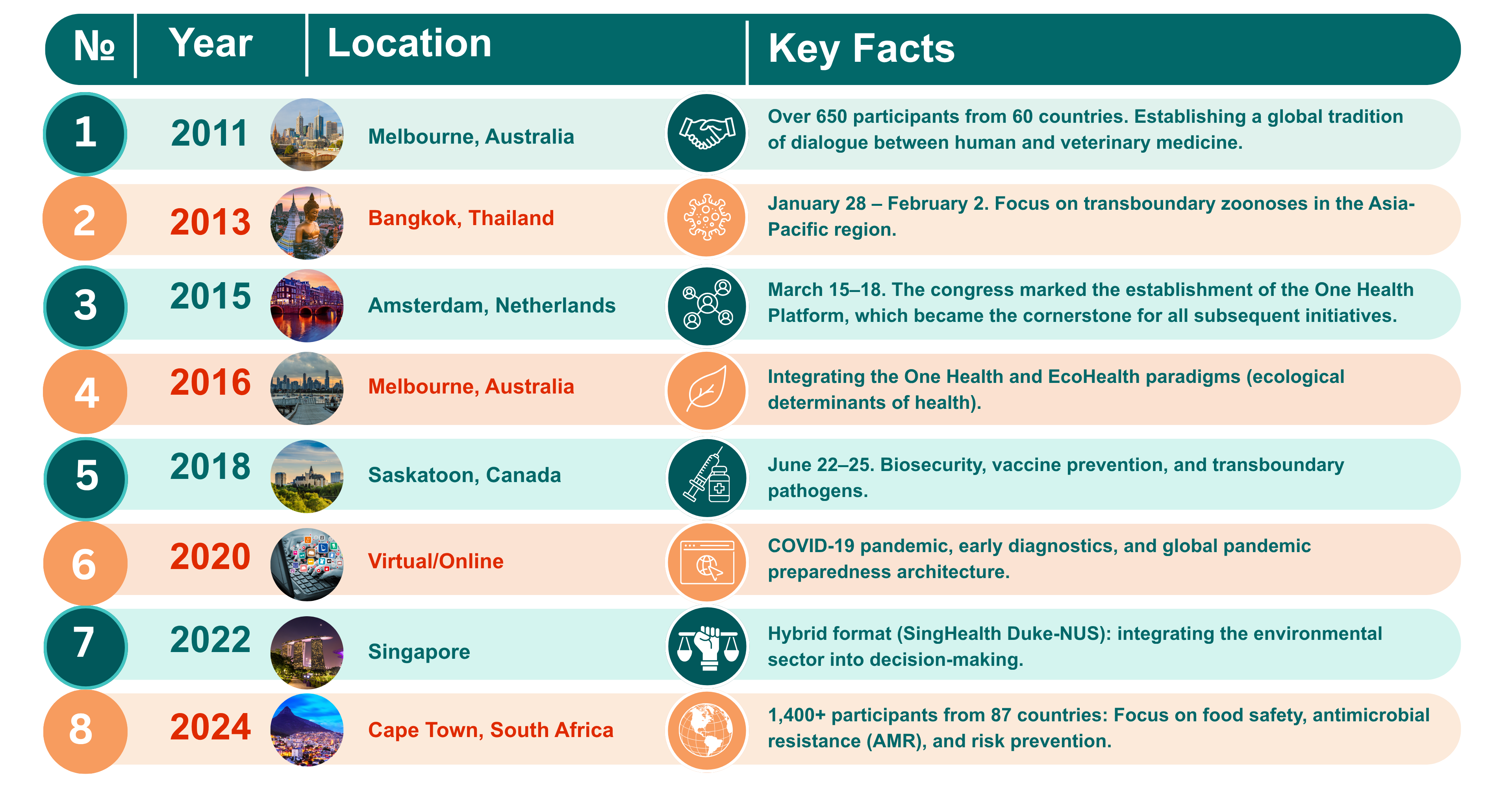
Over its 15-year journey, the WOHC has evolved from a niche academic initiative into a leading global platform convening thousands of participants from dozens of countries. The milestones and venues of all eight congresses are documented on the official Global One Health Community website.
Chronology
Key Achievements of the Movement over 15 Years
-
Institutionalization of the Approach: The One Health concept has evolved from an academic theory into a recognized global policy framework. According to the OHHLEP definition, it is an "integrated, unifying approach that aims to sustainably balance and optimize the health of people, animals, and ecosystems."
-
Establishment of the Quadripartite for One Health: In 2022, the FAO, WHO, WOAH, and UNEP signed a formal cooperation agreement, establishing One Health as the foundational framework for tackling complex, cross-sectoral challenges.
-
Expansion of the Scientific Foundation: The congresses have become a premier platform for showcasing breakthrough research in pathogen genomics, integrated surveillance, vaccinology, and disease ecology.
-
Capacity Building and Workforce Development: Through these events and associated educational initiatives, a new generation of experts has been trained to operate effectively at the intersection of human medicine, veterinary science, and environmental ecology.
9th World One Health Congress — Lisbon 2026
Date and Venue
September 4–7, 2026 | Lisbon, Portugal
The 9th Congress will be a major milestone on the global health calendar. Taking place in Europe during Ireland's Presidency of the Council of the European Union, the event gains added political momentum. The preliminary program already features over 50 sessions.
Program Focus Areas
The congress agenda is structured around two main tracks:
|
Science Track (SCS): |
Science-Policy Interface Track (SPI): |
|
|
.jpeg)
Advancing the One Health Agenda in Central Asia
Regional Geography and Challenges
Central Asia comprises five countries (Kazakhstan, Kyrgyzstan, Tajikistan, Turkmenistan, and Uzbekistan) situated at the crossroads of Europe, Asia, and the Middle East. According to data cited by Chattu et al. (2026), the region's population exceeded 83 million in 2025, with a median age of 26.7 years.
According to World Bank assessments, the rise in infectious diseases across Central Asia is driven by:
-
Expanding human encroachment into natural wildlife habitats
-
Agricultural practices that deplete water resources and biodiversity
-
Intensive livestock farming characterized by low species diversity
Key Regional Threats
-
Antimicrobial Resistance (AMR): Highly prevalent and exacerbated by the overuse and misuse of antibiotics.
-
Climate Change: Heightens the risk of transboundary disease transmission.
-
Shared Ecosystems and Trade Corridors: Create shared vulnerabilities as well as vital opportunities for a coordinated regional response.
Achievements of Central Asian Countries
1. Adoption of the One Health Framework (November 2022)
On November 14, 2022, in Almaty, the Central Asian countries officially launched the Central Asia One Health Framework. Documented in the publication by Chattu et al. (2026) and on the World Bank website, this historic milestone brought together representatives from the Ministries of Health, Agriculture, and Environmental Protection across all five nations. The framework marked a decisive shift from fragmented national actions to a unified, coordinated regional approach.
2. The $27 Million Pandemic Fund Grant
In 2024–2025, the region secured a $27 million grant from the Pandemic Fund, supported by the World Bank. The project aims to:
-
Reduce the risk of disease outbreaks, epidemics, and pandemics;
-
Enhance the resilience of food systems against shocks and climate change;
-
Strengthen agricultural competitiveness, cross-border trade, and ecosystem health.
The initiative comprises four core components:
-
Strengthening multisectoral surveillance systems;
-
Expanding laboratory networks;
-
Building a multisectoral workforce;
-
Enhancing national and regional governance.
Additional co-financing from the World Bank amounts to $561 million (Pandemic Fund).
3. National Achievements (2024–2025) According to data from the Regional Environmental Centre for Central Asia (CAREC):
-
Kazakhstan: Launched a national Pandemic Fund project backed by a $19 million grant and $39 million in co-financing to reinforce epidemic preparedness.
-
Kyrgyz Republic: Completed the world’s first integrated review of antimicrobial resistance across both public health and veterinary sectors, setting a new global benchmark for cross-sectoral surveillance.
-
Tajikistan: Secured a $30 million World Bank grant alongside a $1.79 million Pandemic Fund grant for Phase I of the Regional One Health Program.
-
Turkmenistan: Initiated its inaugural multisectoral One Health coordination meetings, contributing to a shared regional vision.
-
Uzbekistan: Conducted a Joint National Risk Assessment supported by the Quadripartite alliance.
4. First Regional One Health Conference in Central Asia On October 29–31, 2025, Dushanbe, Tajikistan, hosted the first Regional One Health Conference alongside the inaugural meeting of the Regional Coordination Council for the Central Asia One Health Program (ROHCC).
Key outcomes included:
-
Formal launch of the Regional One Health Coordination Structure (ROHCS) — an intergovernmental mechanism designed for aligned action, knowledge exchange, and policy harmonization;
-
Adoption of the ROHCS terms of reference and presentation of its inaugural annual work plan;
-
A scientific symposium featuring experts from WHO, FAO, European Food Safety Authority (EFSA), and International Union for Conservation of Nature and Natural Resources (IUCN);
-
In-depth sessions on AMR, zoonoses, climate-biodiversity-health linkages, and the digitalization of surveillance systems.
5. Regional Health Diplomacy Central Asian states actively utilize Regional Health Diplomacy (RHD) as a strategic vehicle to advance the One Health agenda. As highlighted by Chattu et al. (2026), robust institutional mechanisms have been established:
-
The High-Level Working Group on the implementation of the Central Asia Roadmap in Support of Health and Well-being (CARM);
-
Regular Consultative Meetings of Central Asian Ministers of Health;
-
The Consultative Platform of the Consultative Meetings of the Heads of State of Central Asia.
This governance architecture ensures strong country ownership while maintaining regional cohesion — a vital balance given the region's historical context and multipolar geopolitical landscape.
"Achievements of Central Asian Countries in Implementing the One Health Approach" at the 9th Congress
The presentation titled "Achievements of Central Asian Countries in Implementing the One Health Approach" will be showcased at the 9th World One Health Congress in Lisbon. This marks a pivotal milestone for the region:
Why It Matters
-
Global Visibility: For the first time, Central Asia’s experience will be presented on the premier global One Health stage not as a patchwork of isolated national initiatives, but as a cohesive regional model.
-
Proof of Concept: Central Asia demonstrates that resource-constrained settings with strong political will and multisectoral coordination can establish highly effective mechanisms against global health threats.
-
A Blueprint for Other Regions: As noted by Chattu et al. (2026), the success of the Central Asian framework "may influence similar efforts in other regions facing comparable threats, positioning Central Asia as an emerging knowledge hub for One Health operationalization in developing contexts."
Presentation Highlights: The Lisbon presentation will highlight Central Asia’s transition from high-level political commitments to on-the-ground One Health operationalization.
Representing the Regional Secretariat (ROHCS), speakers will detail the region’s key achievements anchored in CAREC’s successful coordination efforts. Establishing the Secretariat within CAREC formed the backbone of this regional partnership, enabling the rollout of an ambitious $130 million program supported by the World Bank, the Pandemic Fund, and the HEPR Trust Fund. Attendees will gain insights into how CAREC facilitated resource mobilization, established sustainable cross-border dialogue, and secured targeted investments to modernize diagnostic laboratories and integrated surveillance systems across the region.
Conclusion
Over the past 15 years, the World One Health Congress has evolved from an academic discussion in Melbourne into a powerful global movement capable of mobilizing thousands of experts and shaping policy across public health, agriculture, and environmental protection. The 9th Congress in Lisbon marks a new milestone—particularly for Central Asia, which will present its integrated regional experience on the global stage for the first time.
The region's achievements—ranging from the adoption of the One Health Framework to the operational launch of the Regional Coordination Council, and from conducting the world's first integrated AMR review to securing multimillion-dollar international funding—demonstrate institutional maturity and strong political commitment. Central Asia proves that One Health is far from an abstract concept; it is an actionable instrument for regional stability, resilience, and the advancement of global health security.
References:
1. CDC — One Health History: Timeline and history of the One Health movement, including data on the 1st and 2nd congresses.
2. Global One Health Community — What we do: History, mission, and the record of all eight congresses
3. Global One Health Community — 8th WOHC: Information on the 8th Congress (Cape Town, 2024).
4. Global One Health Community — 9th WOHC: Official website of the 9th Congress (Lisbon, 2026).
5. Global One Health Community — Program 9th WOHC: Preliminary program of the 9th Congress.
6. One Health Commission — 5th International One Health Congress: Information on the 5th Congress (Saskatoon, 2018).
7. WHO — One Health Definition and Principles (OHHLEP): Official definition of One Health
8. FAO — One Health Global Policies and Declarations: Global policies and declarations of the Quadripartite alliance.
9. World Bank — Central Asia One Health Meeting: Endorsement of the Central Asia One Health Framework.
10. World Bank Blog — Why a One Health approach is so crucial for Central Asia: Analysis of regional challenges and the necessity of the approach.
11. Pandemic Fund — Central Asia Project: $27M grant details, objectives, components, and co-financing.
12. CAREC — One Health Regional Conference Dushanbe 2025: First regional conference and the launch of ROHCS/ROHCC.
13. Chattu V.K. et al. (2026) — Cross-Border Cooperation for One Health in Central Asia: · Scientific paper in Health Promotion Perspectives, 16(1):14–21. Data on population demographics, AMR, regional health diplomacy, the One Health Framework, and regional outlook.
14. WHO — Roadmap for Health and Wellbeing in Central Asia (CARM): Central Asia Roadmap in Support of Health and Well-being.
Shoira Toirova
PR Specialist, One Health Program