

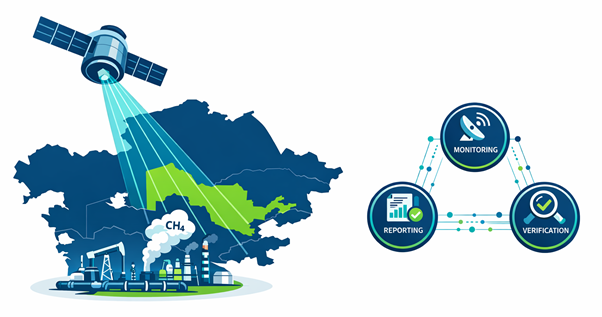
The CA CBMER project held its introductory seminar in Uzbekistan, bringing together national stakeholders and international technical partners to discuss how satellite data can support the methane emissions monitoring, reporting, and verification (MRV) system and strengthen the national greenhouse gas inventory.
The session was attended by representatives of key national authorities, including the National Committee on Ecology and Climate Change, Uzbekcosmos, Uzbekneftegaz, and the Ministry of Energy, alongside technical experts and project partners supporting the implementation of the CA CBMER initiative.
Focus of the Meeting During the seminar, participants were introduced to the rapidly evolving ecosystem of methane-monitoring satellites. It was explained how satellite observations (the "top-down" approach) can be compared and combined with national greenhouse gas inventory data and facility-level data (the "bottom-up" approach) to improve transparency, accuracy, and the quality of decision-making.
The meeting also outlined the project’s plans to support Uzbekistan, which include:
● improving the alignment between satellite observations and the national inventory;
● enhancing the capacity of national experts to work with satellite methane data;
● advancing analytical work that will serve as a foundation for planning and prioritizing emission reduction measures (including economic aspects).
Key Contributions from International Partners The Environmental Defense Fund (EDF) supports the CA CBMER initiative and promotes the enhanced use of satellite data to strengthen the methane measurement, reporting, and verification (MRV) system and national inventory documents (NID/NIR).
Dr. Luis Guanter (EDF) presented an accessible overview of satellite methods for methane detection, explaining the difference between global coverage satellites ("area flux mappers") and high-resolution satellites for detecting point sources ("point source imagers"). He also shared illustrative examples relevant to Kazakhstan and Uzbekistan.
Itziar Irakulis Loitxate (UNEP IMEO) introduced the International Methane Emissions Observatory (IMEO) and the Methane Alert and Response System (MARS). She explained how satellite-detected emissions are translated into actionable notifications for countries and subsequent mitigation actions in coordination with national focal points and facility operators.
Engagement and Next Steps The discussion demonstrated a high level of interest from national partners in establishing practical channels for timely data exchange and responding to detected emission events. Participants also emphasized the importance of obtaining aggregated data that could be compared with national inventory estimates.
Following this introductory session, the CA CBMER project will continue its engagement with national stakeholders. Later this spring, a second, more technical meeting is planned to review the project's initial findings specific to Uzbekistan and to agree on the next steps for project implementation.
For more information about CA CBMER activities in Uzbekistan and upcoming sessions, please contact the project team or follow the updates on the project website.
#Methane #MethaneReduction #ClimateAction #CentralAsia #Transparency #CarbonNeutrality #ClimateChangeMitigation #SustainableDevelopment #ParisAgreement #RegionalCooperation #GHG #ИОП #MRV #Satelitemonitoring #EDF
Contacts:
● Dilovarsho Dustzoda – CA CBMER Project Manager (recath_manager@carececo.org)
● Arailym Shulgauova – CA CBMER Project Specialist (ashulgauova@carececo.org)
#Methane #MethaneReduction #ClimateAction #CentralAsia #Transparency #CarbonNeutrality #ClimateChangeMitigation #SustainableDevelopment #ParisAgreement #RegionalCooperation #GHG #ИОП #MRV #Satelitemonitoring #EDF