
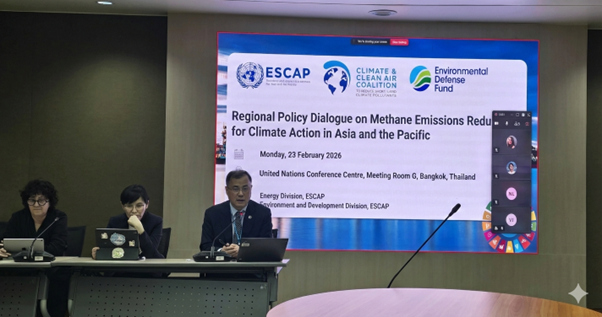
BANGKOK, February 23, 2026 — Representatives from the Regional Environmental Centre for Central Asia (CAREC) participated in the Regional Policy Dialogue on Methane Emissions Reduction for Climate Action in Asia and the Pacific. Organized by UN ESCAP in partnership with the Environmental Defense Fund (EDF) and the Climate and Clean Air Coalition (CCAC), the event was held as part of the 13th Asia-Pacific Forum on Sustainable Development (APFSD).
During the session, Oxana Kravtsova, CAREC’s Environment and Health Programme Manager, delivered a report titled "Central Asia's Methane Challenge: From Pledges to Progress." The presentation provided an analysis of the current regional landscape and an overview of the practical steps being taken to meet climate targets.
Oxana Kravtsova noted that methane reduction is one of the most effective tools for curbing global warming in the short term due to the gas’s high potency and relatively short atmospheric lifespan (approximately 12 years).
The report outlined the emission structures across the region:
● Energy Sector: В In Kazakhstan, Uzbekistan, and Turkmenistan, a significant portion of emissions is linked to the extraction of oil, gas, and coal. It was noted that the scale of tasks in this sector remains substantial, particularly regarding the reduction of fugitive leaks.
● Waste and Agriculture: In Kyrgyzstan and Tajikistan, the primary sources are livestock and waste management. Increasing waste volumes driven by urbanization require the implementation of modern monitoring systems at landfills.
Despite differences in economic structures, all five Central Asian countries are united by the common goal of implementing commitments under the Global Methane Pledge.
To support regional efforts, CAREC is implementing the "Central Asia Capacity Building for Methane Emission Reduction" (CA CBMER) project (2025–2027), funded by the Global Methane Hub. The project aims to create a sustainable foundation for long-term change through:
- Data Management: Identifying gaps in regional data and utilizing monitoring tools (such as WasteMAP) to pinpoint emission hotspots.
- Expert Support: Training specialists in Measurement, Reporting, and Verification (MRV) systems.
- Project Preparation: Developing pre-feasibility studies for pilot projects across various sectors to make them eligible for international climate finance.
- Regulatory Support: Assisting in the integration of methane targets into national strategies and NDC 3.0 updates.
The report placed special emphasis on the link between environmental health and public health. CAREC, serving as the Secretariat for the "One Health" program in Central Asia, facilitates interagency coordination. Methane mitigation is viewed not only as a climate objective but as a way to improve quality of life—for example, by preventing water contamination and improving the sanitary conditions of urban areas.
In conclusion, it was noted that Central Asia’s experience could be valuable for other countries in the Asia-Pacific region facing similar challenges. CAREC reaffirmed its readiness to serve as a platform for knowledge exchange and technical cooperation via South-South collaboration.
"The Global Methane Pledge provides a common framework," concluded Oxana Kravtsova. "Our task now is to turn these intentions into consistent actions through partnership and technical exchange."
#Methane # MethaneEmissionReduction #ClimateAction #CentralAsia #CACBMER #EDF