

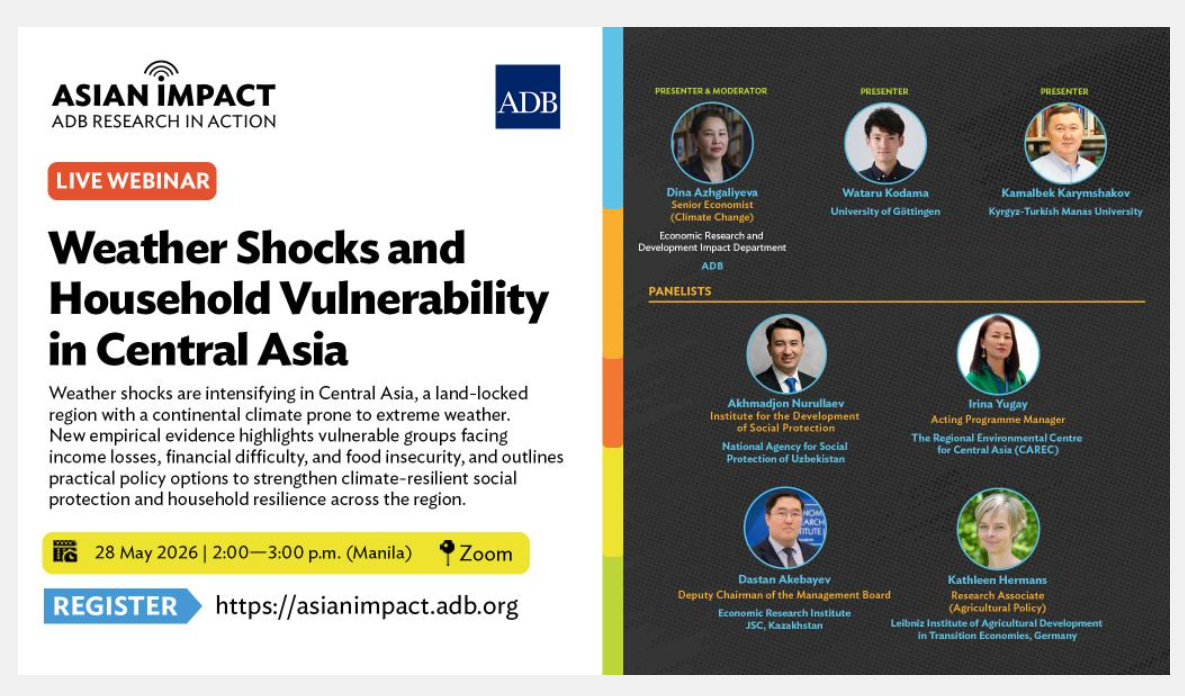
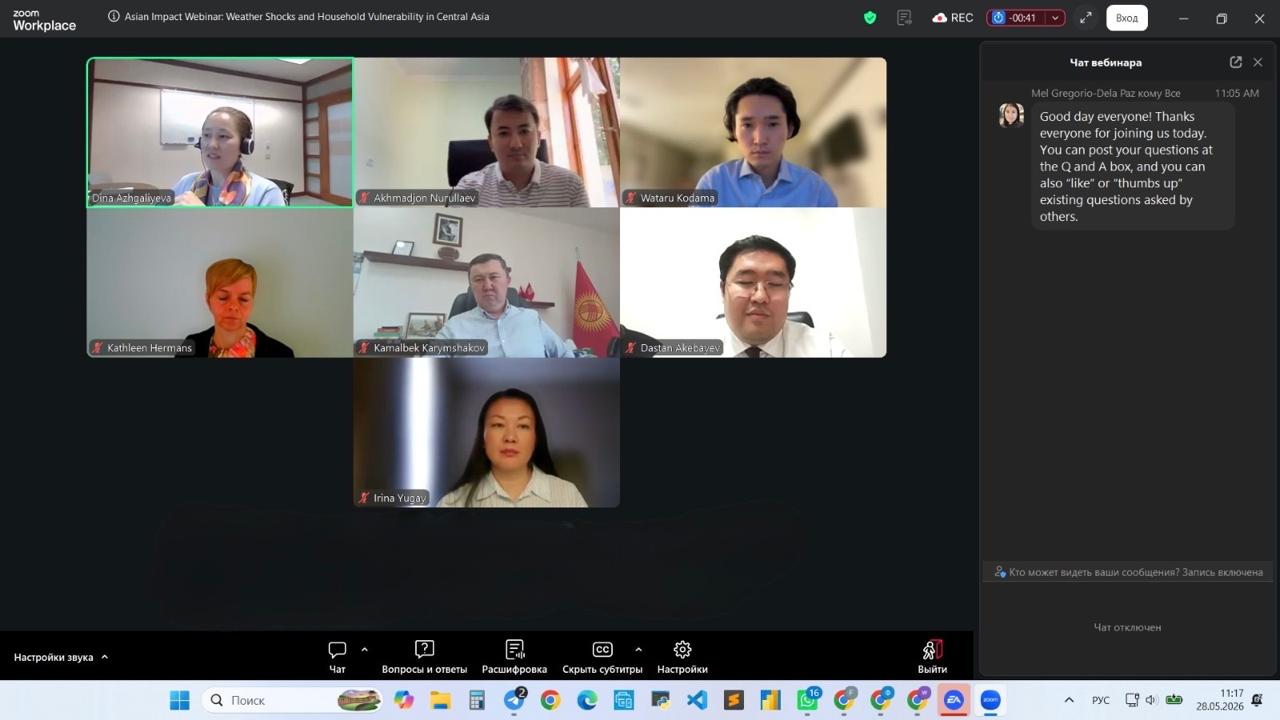
On 28 May, the Asian Impact webinar “Weather Shocks and Household Welfare in Central Asia: Evidence from Household Panel Data” was held online. Irina Yugay, Acting Manager of the Water Initiatives Support Programme at the Regional Environmental Centre for Central Asia (CAREC), took part in the panel discussion.
The webinar was held as part of the Asian Impact series organized by the Asian Development Bank to present relevant research and discuss key development issues affecting countries across Asia and the Pacific.
The discussion focused on a study based on household panel survey data collected between 2021 and 2023 in Kazakhstan, the Kyrgyz Republic, Tajikistan, Turkmenistan, and Uzbekistan, together with satellite-based weather data. The study examines how rainfall shortages and other climate shocks affect household incomes, financial hardship, and food security.
Particular attention was paid to the most vulnerable population groups, including low-income households and female-headed households, as well as opportunities to strengthen climate-resilient social protection in the region.
Speaking during the panel discussion, Irina Yugay noted that one of the key challenges is the limited translation of scientific research into practical solutions. According to her, Central Asian countries already possess a substantial body of data and models on droughts, floods, and other climate-related hazards. However, this knowledge is not yet sufficiently reflected in strategic planning, budgeting, and the preparation of investment projects.
She emphasized the need to systematically integrate climate risks into national development programmes and river basin management plans. Equally important is the consideration of climate vulnerability in the allocation of public resources and the development of targeted support measures for rural communities, women, and low-income households.
Attention was also drawn to the need to prepare finance-ready adaptation projects, develop insurance instruments, and strengthen cooperation among researchers, hydrometeorological services, public authorities, local governments, and financial institutions, both within each country and across the region.
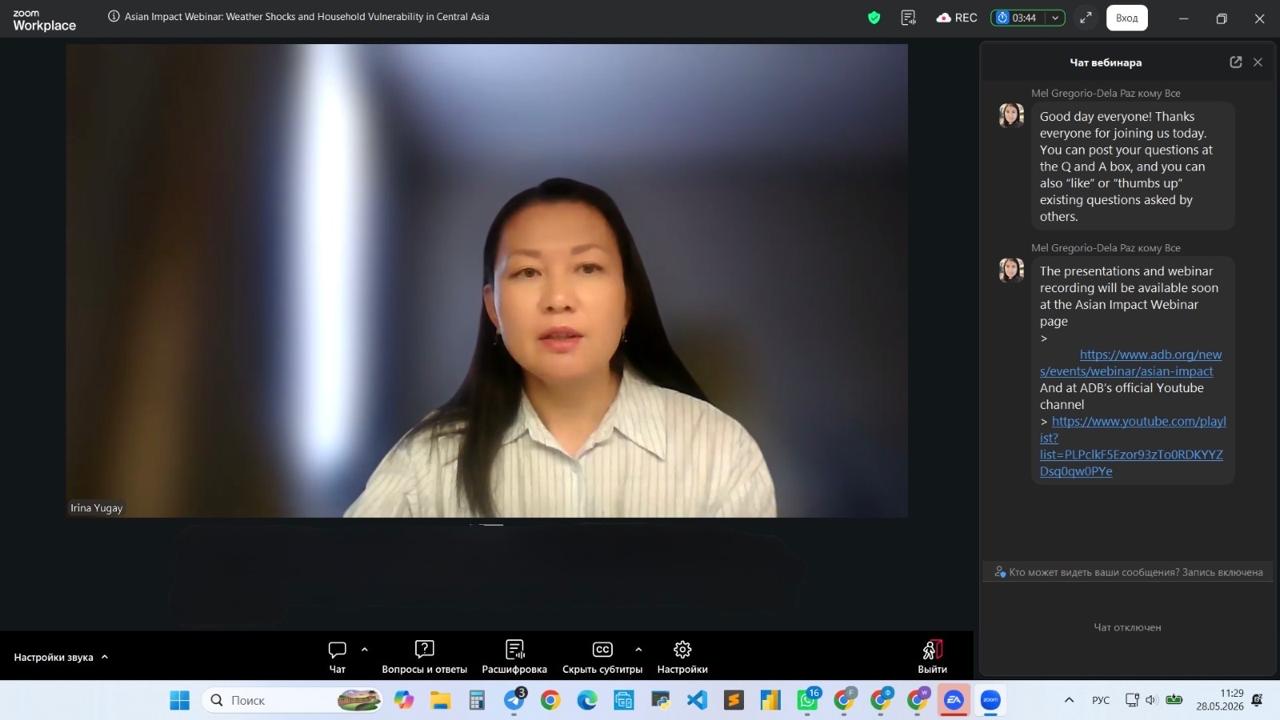
resilient social protection in the region.
Speaking during the panel discussion, Irina Yugay noted that one of the key challenges is the limited translation of scientific research into practical solutions. According to her, Central Asian countries already possess a substantial body of data and models on droughts, floods, and other climate-related hazards. However, this knowledge is not yet sufficiently reflected in strategic planning, budgeting, and the preparation of investment projects.
She emphasized the need to systematically integrate climate risks into national development programmes and river basin management plans. Equally important is the consideration of climate vulnerability in the allocation of public resources and the development of targeted support measures for rural communities, women, and low-income households.
Attention was also drawn to the need to prepare finance-ready adaptation projects, develop insurance instruments, and strengthen cooperation among researchers, hydrometeorological services, public authorities, local governments, and financial institutions, both within each country and across the region.
The role of regional platforms was also highlighted, including the Central Asia Climate Change Conference (CACCC), held last month on the sidelines of the Regional Environmental Summit in Astana. Such platforms contribute to knowledge exchange and the development of coordinated approaches to addressing transboundary climate risks.
During the discussion, participants also emphasized the role of regional organizations such as CAREC in connecting scientific evidence, policy decisions, and action at the local level.
One example is a transdisciplinary study conducted by researchers from the Leibniz Institute of Agricultural Development in Transition Economies (IAMO), with the support of CAREC, to assess the resilience of rural communities in the Fergana Valley. The project combines household data, socio-economic and geospatial indicators, as well as engagement with local communities, to better understand how various shocks affect incomes, employment, migration, food security, and people’s well-being.
Participants of the webinar emphasized that effective climate change adaptation requires not only high-quality research, but also its translation into concrete, prioritized measures aimed at supporting communities most vulnerable to climate impacts.
Recordings of previous webinars can be viewed via this link.
For further information:
Irina Yugay Acting Manager, Water Initiatives Support Programme
Regional Environmental Centre for Central Asia (CAREC) i.yugay@carececo.org