
Immediately after the conclusion of the 17th Conference of the Parties to the United Nations Convention to Combat Desertification (UNCCD COP17), held in Ulaanbaatar on 17–28 August 2026, the 3rd Central Asian Organic Forum & Expo – 2026 took place in the capital of Mongolia. The Forum, organized on 29–30 August by the NGO “Silk Road Peace Ambassador” with the support of the Ministry of Food, Agriculture and Light Industry of Mongolia, became a practical continuation of the international discussion on land restoration, pasture resilience, soil health and food-system transformation — issues that also featured prominently on the COP17 agenda.
The 3rd Central Asian Organic Forum brought together representatives of government institutions, academia, business, producers, certification bodies and international organizations. According to the published results, more than 200 representatives from the Central Asian countries, Mongolia, China, India and the Republic of Korea took part in the event. The Forum focused on the development of organic production, sustainable food systems, responsible supply chains, regional markets and technological cooperation.
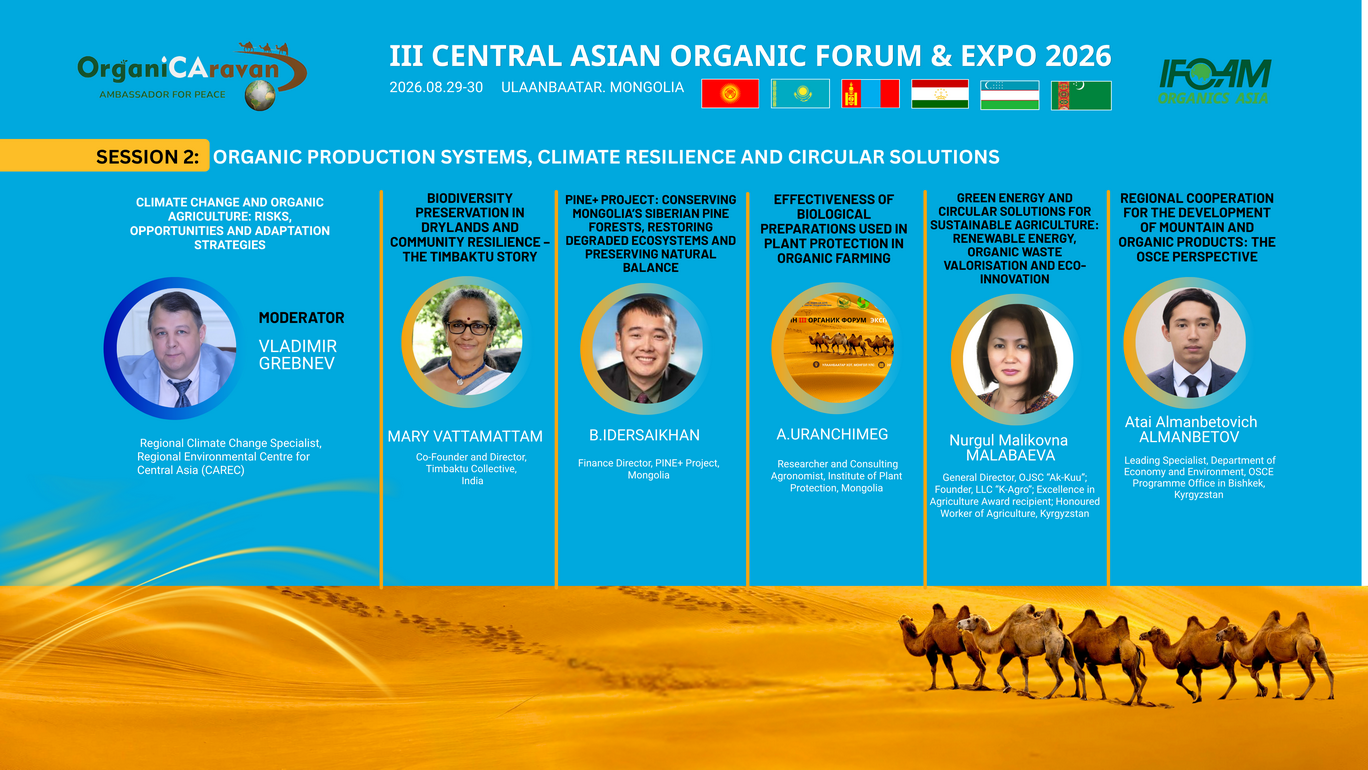
Vladimir Grebnev, Regional Climate Change Specialist at the Central Asian Regional Environmental Centre (CAREC) and an internationally recognized expert in climate change adaptation, was invited to moderate Session 2, “Organic Production Systems, Climate Resilience and Circular Solutions.” The session brought together experts from India, Mongolia and the Kyrgyz Republic, who presented practical and scientific approaches to biodiversity conservation, biological plant protection, green energy and circular economy solutions, promotion of mountain and organic products, and adaptation of agriculture to climate risks.
One of the main elements of the session was Vladimir Grebnev’s keynote presentation, “Climate Change and Organic Agriculture: Risks, Opportunities and Adaptation Strategies.” The central message of the presentation was that “organic production of the future must be not only environmentally sound, but also climate-resilient”: compliance with an organic standard alone does not guarantee that a farm can withstand droughts, water scarcity, extreme heat, soil degradation or climate risks affecting pastures.
The presentation highlighted that water is becoming the main limiting factor for agricultural adaptation in Central Asia: agriculture accounts for around 90% of freshwater use, while by 2050 water availability in the region could decline by 25–31% and irrigation-water demand could increase by around 15%. For Mongolia, particular attention was given to pasture resilience: the country’s average temperature increased by approximately 2.46°C between 1940 and 2022, while the 2023–2024 dzud caused the loss of around 6.6–7.1 million head of livestock, or roughly 10% of the national herd.
Particular emphasis was placed on the need to move from a traditional organic-production assessment toward Climate Risk Screening at the farm-planning stage. Proposed practical measures included increasing soil organic matter, precision and drip irrigation, moisture conservation, crop diversification, use of local and drought-resistant varieties, rotational grazing, fodder reserves, and development of agrometeorological services and early-warning systems.
Particular interest was generated by the proposed transition from “organic” to “climate-resilient organic.” As a promising direction, Vladimir Grebnev proposed considering a voluntary supplementary verification approach combining organic certification, Land Degradation Neutrality indicators and Climate Risk Screening. This approach was also proposed and supported during the UNCCD COP17 side event “One Steppe Forward: Regional Dialogue on Land Restoration and Resilience in Northern and Central Asia,” organized by the Nature and People Foundation (Russia). Such verification could confirm not only the production method, but also that the land is not degrading, the farm is adapted to climate risks, and the achieved results are supported by data and independent verification.
This proposal directly echoes the outcomes of UNCCD COP17, where sustainable management of agricultural land, restoration of soils and pastures, transformation of food systems, and private-sector engagement were among the key themes. COP17 adopted the Ulaanbaatar Declaration “Restoring Land, Restoring Hope,” a dedicated decision on rangelands and pastoralists, while the Committee on Science and Technology considered approaches to avoiding, reducing and reversing agricultural land degradation.
CAREC’s participation in the Organic Forum continued the Centre’s broader engagement at UNCCD COP17. During the Conference, CAREC presented regional approaches to consolidating Central Asian countries in the face of climate threats and land degradation, as well as approaches to digitalization, regional cooperation and landscape resilience. In addition, during an official IWMI side event at COP17, Vladimir Grebnev represented Central Asia in a discussion on preparedness for El Niño 2026, transboundary water-energy planning, and the transition from climate forecasting to anticipatory action.
Additional information: Vladimir Grebnev, Regional Climate Change Specialist, CAREC, cc_specialist@carececo.org