

17 November 2026, Antalya, Türkiye
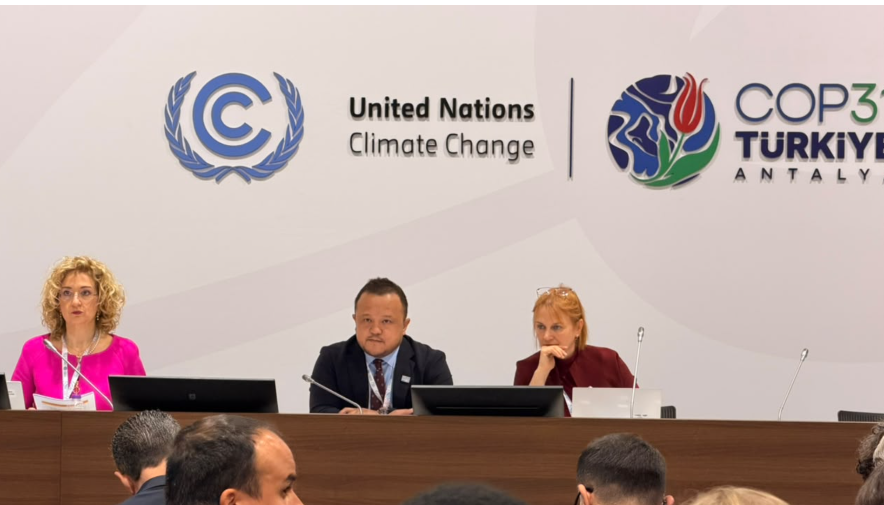
The Regional Environmental Centre for Central Asia (CAREC) took part in the high-level side event "Scaling up Sustainable Infrastructure through NbS for Climate Adaptation: the NBS-IA Initiative", held on 17 November 2026 at the UNFCCC Pavilion during the 31st Conference of the Parties to the UN Framework Convention on Climate Change (COP31) in Antalya, Türkiye.
Organised by the Italian Ministry of Environment and Energy Security (MASE) in partnership with the United Nations Environment Programme (UNEP) and the Organisation for Economic Co-operation and Development (OECD), the event brought together government officials, international financial institutions, private sector leaders, and academia. Participants explored the rollout of hybrid "green-grey" infrastructure solutions and announced the first pilot projects selected under the NBS-IA initiative.
Lyudmila Kiktenko, Environmental Management Programme Manager at CAREC, delivered a keynote address during the session dedicated to climate-resilient infrastructure and Nature-based Solutions (NbS). Discussions centred on practical ways to integrate nature into urban, transport, and water infrastructure, as well as removing regulatory and financial barriers to scaling up these approaches.
From Isolated Pilots to Systemic Infrastructure Adaptation in Central Asia
In her address, Ms Kiktenko underscored the growing urgency of Nature-based Solutions for Central Asia, a region warming faster than the global average. Prolonged heatwaves, acute water scarcity, and dust and salt storms are placing severe strain on critical infrastructure — including residential buildings, schools, hospitals, roads, and water supply networks — built decades ago without accounting for temperatures exceeding 45°C.
"Relying solely on heavy concrete and traditional engineering is far too costly for municipal budgets. At the same time, simply planting trees in an arid climate without smart water management does not work," noted Lyudmila Kiktenko. "By combining nature with smart engineering — for instance, pairing drought-resistant green belts and green roofs with simple rainwater harvesting systems — we achieve practical, affordable results: we capture scarce spring rainfall without straining municipal water supplies, cool down buildings, and shield residents from dust storms."
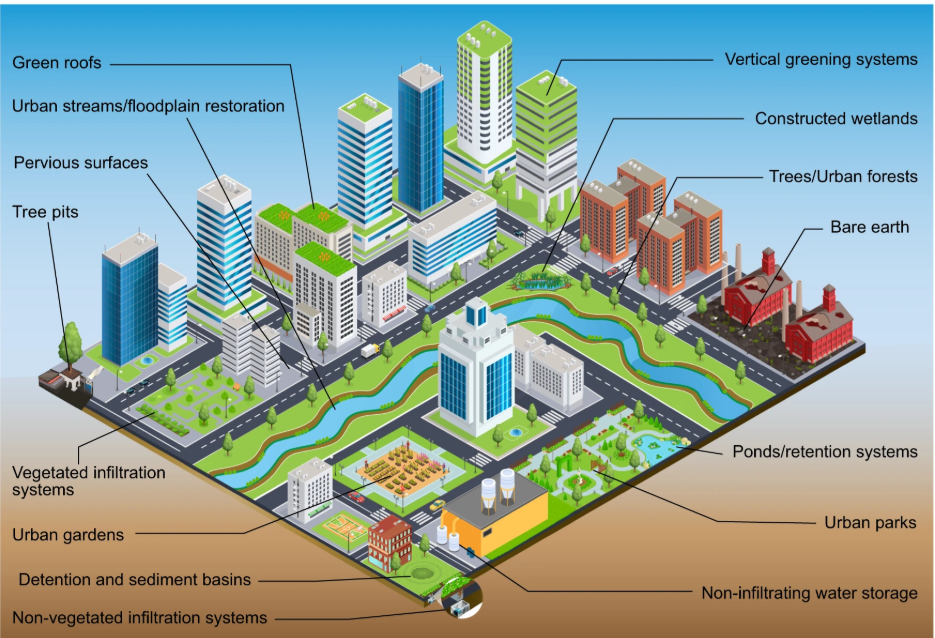
Examples of integrating green infrastructure into the urban environment. Source:: Cook et al., npj Urban Sustainability (2024)
Overcoming Legislative Barriers and Advancing Regional Cooperation
During the session, CAREC outlined a vision for systemic measures needed to move from isolated pilot initiatives to integrating hybrid "green-grey" solutions into national investment pipelines.
According to CAREC's assessment, the widespread adoption of Nature-based Solutions across Central Asia is currently hindered by three key factors: the absence of a clear legal definition of NbS in national legislation; outdated construction codes and technical standards (SNiPs) that do not recognise hybrid engineering; and public procurement rules focused strictly on the lowest upfront price, which automatically favours conventional concrete.
To address these hurdles, CAREC proposed launching a parallel regional policy track that includes:
- establishing a joint Regional Working Group comprising parliamentarians and line ministries to monitor pilot projects, assess the potential of NbS for infrastructure assets, and draft necessary legislative amendments;
- utilising the annual Central Asian Climate Change Conference (CACCC) as a platform to showcase successful practices to decision-makers and development banks;
- developing a unified monitoring system to standardise performance data and lessons learnt from pilot projects;
- promoting NbS approaches, practical insights, and success stories across CAREC’s regional platforms.
Particular emphasis during the discussion was placed on engaging the private sector. Without private capital, technological innovation, and managerial expertise, scaling climate-resilient infrastructure beyond standalone donor-funded pilots remains unfeasible.
The panel featured senior representatives from the Italian Ministry of Environment and Energy Security (MASE), the United Nations Environment Programme (UNEP), the Organisation for Economic Co-operation and Development (OECD), the World Bank, the European Bank for Reconstruction and Development (EBRD), the African Development Bank (AfDB), and the Italian national promotional institution Cassa Depositi e Prestiti (CDP). Financial institutions confirmed their strong interest in supporting hybrid solutions, while noting that unlocking large-scale investment will require introducing new climate-resilience appraisal criteria, expanding public-private partnerships (PPPs) and concessions, and deploying blended finance and climate insurance instruments to de-risk projects.
Valerie Hickey, Director for Environment at the World Bank, echoed CAREC's position on the critical importance of regulatory reform. She confirmed that outdated construction standards directly restrict banks and contractors from applying hybrid engineering in major infrastructure projects, making regulatory updates a prerequisite for attracting systemic financing.
 CAREC will continue to serve as a regional partner, facilitating knowledge exchange across Central Asia and strengthening collaboration among governments, academia, the private sector, and international financial institutions to scale up climate-resilient infrastructure throughout the region.
Author: Lyudmila Kiktenko — Environmental Management Programme Manager, Deputy Team Leader of the Resilient Landscape Restoration Project in Kyrgyzstan: Regional Component, CAREC. lkiktenko@carececo.org
#COP31, #NBS #climatechange