
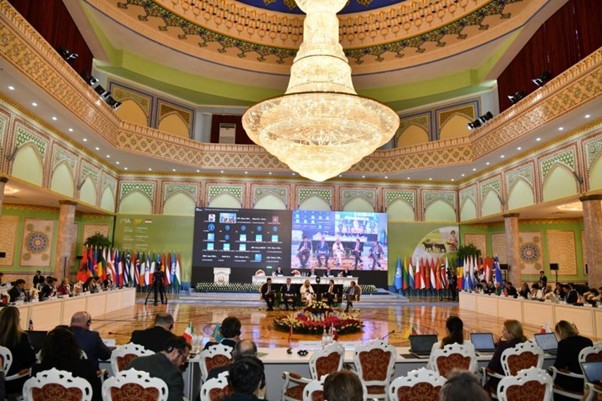
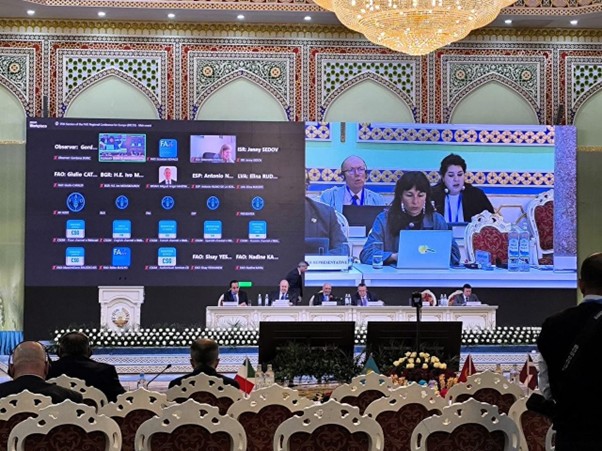
DUSHANBE, Tajikistan – 12 May 2026 – Speaking today at a side event of the 35th Session of the FAO Regional Conference for Europe (ERC35), the Regional One Health Secretariat for Central Asia underscored the critical role of cross-border cooperation and neutral regional platforms in combating transboundary animal diseases (TADs) and advancing the One Health agenda across Europe and Central Asia.
The side event, titled “One Health and transboundary animal diseases in Europe and Central Asia: the role of the global partnership in advancing integrated prevention, preparedness and response,” brought together regional stakeholders to discuss the escalating threats posed by diseases such as African swine fever, foot-and-mouth disease, and highly pathogenic avian influenza—threats that the FAO’s background document ERC/26/6 notes have affected dozens of countries across the region in the past biennium.
Complementing Global Expertise with Regional Coordination
In her address, Ms. Oxana Kravtsova, Coordinator of the “One Health for Pandemic Prevention, Food Systems Resilience, and Ecosystem Health in Central Asia (Phase 1)” program, speaking on behalf of the Regional One Health Secretariat hosted by the Regional Environmental Centre for Central Asia (CAREC), emphasized that the Secretariat does not duplicate the work of Quadripartite partners (FAO, WOAH, WHO, UNEP). Instead, it fulfills a specific, niche mandate: facilitating cooperation between countries.
“FAO and Quadripartite partners provide global standards, technical guidance, laboratory protocols, and risk assessment tools. This work is essential,” said Kravtsova. “The Regional Secretariat focuses on what one country alone cannot do—cross-border coordination. We take the data, methods, and tools developed by FAO and partners and bring them to the multi-country level, enabling real-time data sharing, peer learning, and coordinated response.”
Concrete Regional Actions Underway
Kravtsova highlighted two flagship initiatives demonstrating the Secretariat’s practical value:
- Cross-Border Simulation Exercises: Using FAO and WHO methodologies, the Secretariat is supporting the first tabletop exercise between Kyrgyzstan and Tajikistan on a zoonotic outbreak scenario. The exercise allows both countries to test communication channels, data sharing protocols, and joint decision-making before an actual emergency occurs.
- Regional One Health Information Portal: This centralized platform collects FAO guidelines, WOAH standards, and WHO risk assessments, translating key materials into Russian and national languages. The portal adds a regional layer through cross-border alerts, a Functional Commitment Tracker, and a community of practice for One Health professionals in Central Asia.
Aligning with ERC35 Recommendations
The Secretariat’s work directly supports the core recommendations outlined in FAO document ERC/26/6. Kravtsova noted particular alignment with Recommendation 1, which calls on member states to “endorse the reinforcement and integration of One Health governance mechanisms at national and regional levels, with formalized multisectoral coordination platforms.”
“The Regional Secretariat—with its Regional Coordination Council and Technical Working Groups—is precisely such a platform,” she affirmed. “We are ready to serve as a neutral, regional mechanism for cross-border coordination, working hand-in-hand with FAO and Quadripartite partners in full complementarity.”
A Call for Sustained Partnership
The side event concluded with an open invitation to FAO, WOAH, WHO, UNEP, and member states to continue providing technical guidance and to utilize the Secretariat as a trusted regional mechanism for addressing shared health threats. As FAO’s ERC/26/6 document highlights, workforce and economic limitations in low- and middle-income countries inhibit capacity development—a gap that regional coordination is uniquely positioned to fill.
“We fully support the findings of ERC/26/6,” Kravtsova stated. “The key question is how we support countries in a practical, coordinated way. The Regional One Health Secretariat is designed to help deliver concrete results.”
About the Regional One Health Secretariat for Central Asia Hosted by the Regional Environmental Centre for Central Asia (CAREC), the Secretariat supports the implementation of the One Health approach across Central Asia by strengthening cross-border coordination, facilitating multi-country simulation exercises, and providing a regional information platform. It operates under the broader framework of the Regional One Health Coordination Mechanism for Europe and Central Asia (established 2021).
Media Contact:
Oxana Kravtsova - Regional One Health Program Coordinator, okravtsova@carececo.org
Irina Bubenko - Regional One Health Program Specialist, ibubenko@carececo.org