

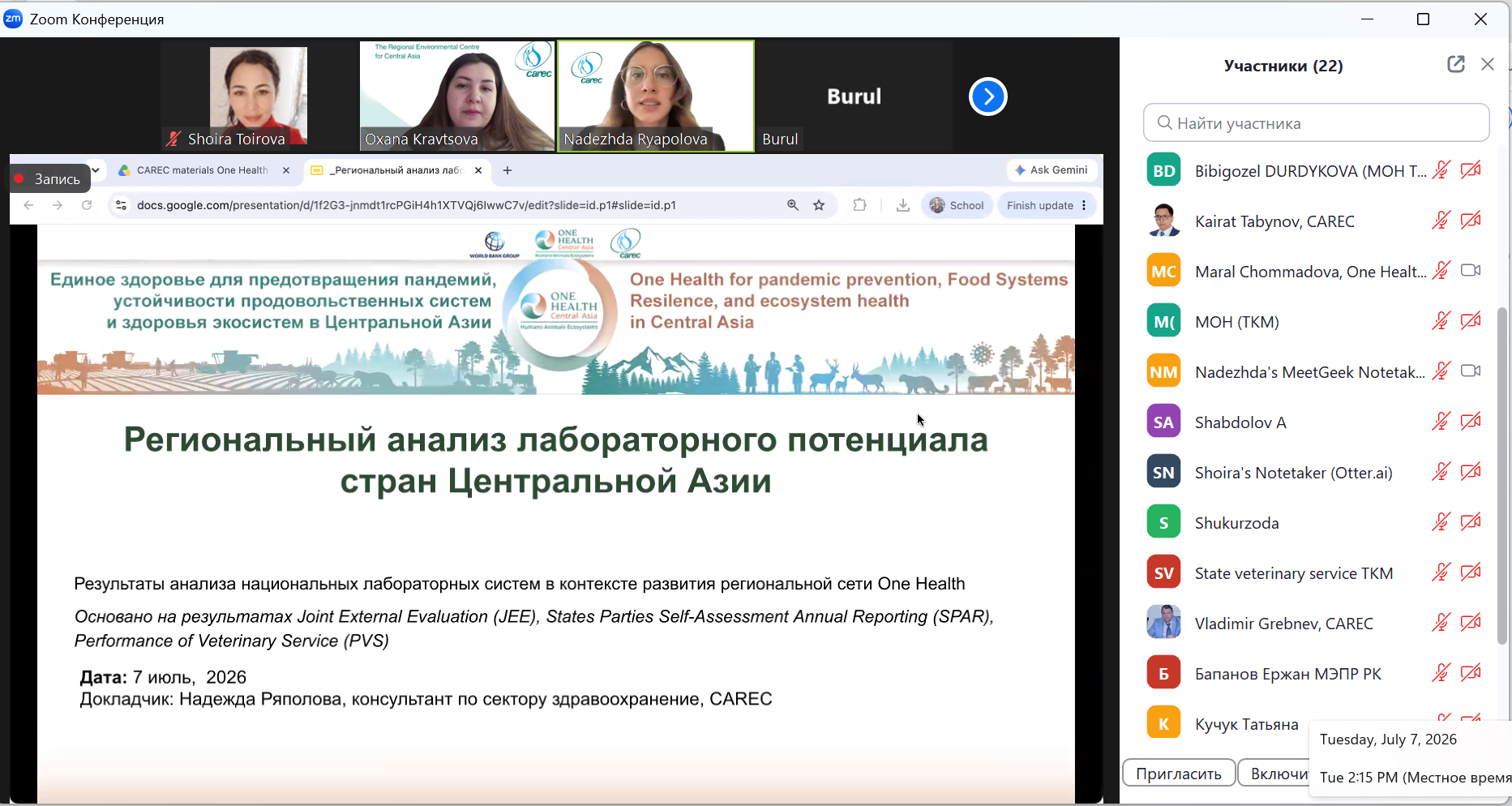
On July 7, 2026, the Technical Working Group on the Regional Laboratory Strategy held its first meeting, aimed at strengthening laboratory networks and diagnostic capacity across Central Asian countries.
The online meeting was organized under the Regional One Health Program in Central Asia. It brought together representatives from relevant ministries, agencies, and laboratory services of the region, alongside experts from the Regional Secretariat of the One Health Program, hosted by the Regional Environmental Center for Central Asia (CAREC).
The primary objective of the meeting was to discuss the preliminary analysis of laboratory capacity in Central Asian countries and to define strategic and practical steps for advancing regional cooperation. Participants discussed the strengths of existing laboratory systems, key gaps, issues regarding accreditation and quality management, digitalization, professional training, and data sharing.
According to the presented data, Central Asia already possesses a substantial laboratory infrastructure, accumulated experience in international cooperation, and functioning national reference laboratories. At the same time, the region's laboratory systems face common challenges: insufficient funding, uneven development of national-level laboratories, shortages of qualified personnel, weak implementation of quality management systems, and a limited number of laboratories accredited to international standards.
Among other challenges, participants highlighted the fragmentation of laboratory systems across the human health, veterinary, and food safety sectors, underdevelopment of Laboratory Information Management Systems (LIMS), limited sequencing and bioinformatics capabilities, and the lack of unified mechanisms for data exchange.
Regional Analysis: The Big Picture and Country Differences
A preliminary comparative analysis of laboratory capacity in Central Asian countries was presented to the participants. Its purpose is to assess the potential for developing a regional laboratory network within the framework of the One Health approach.
The analysis is based on several international assessment tools: the Joint External Evaluation (WHO/JEE), the State Party Self-Assessment Annual Reporting (WHO/SPAR), and the Performance of Veterinary Services Evaluation (WOAH/PVS).
These international assessments were conducted in different years and using different methodologies, and some of the publicly available data is already in need of an update.
The preliminary analysis confirmed that the region possesses important strengths. National reference laboratories are operational across the countries, major priority diseases are being diagnosed, modern molecular diagnostic methods are in use, and quality control programs along with epidemiological surveillance mechanisms are being expanded. Furthermore, the region has gained significant experience in international cooperation, creating a solid foundation for a broader application of the One Health approach.
At the same time, common systemic barriers persist. These include a high dependence on international donor support, challenges with logistics and sample traceability, varying levels of quality management system implementation, fragmented governance, and a shortage of high-level biosafety laboratories.
Accreditation: A Central Theme of the Meeting
A significant part of the discussion focused on laboratory accreditation and the application of the international standard ISO/IEC 17025.
Country representatives shared their national experiences and outlined ongoing efforts to prepare laboratories for accreditation. In particular, participants emphasized that preparing for accreditation requires not only financial resources but also qualified expert support—primarily in developing and preparing documentation, implementing quality management systems, and undergoing assessment procedures.
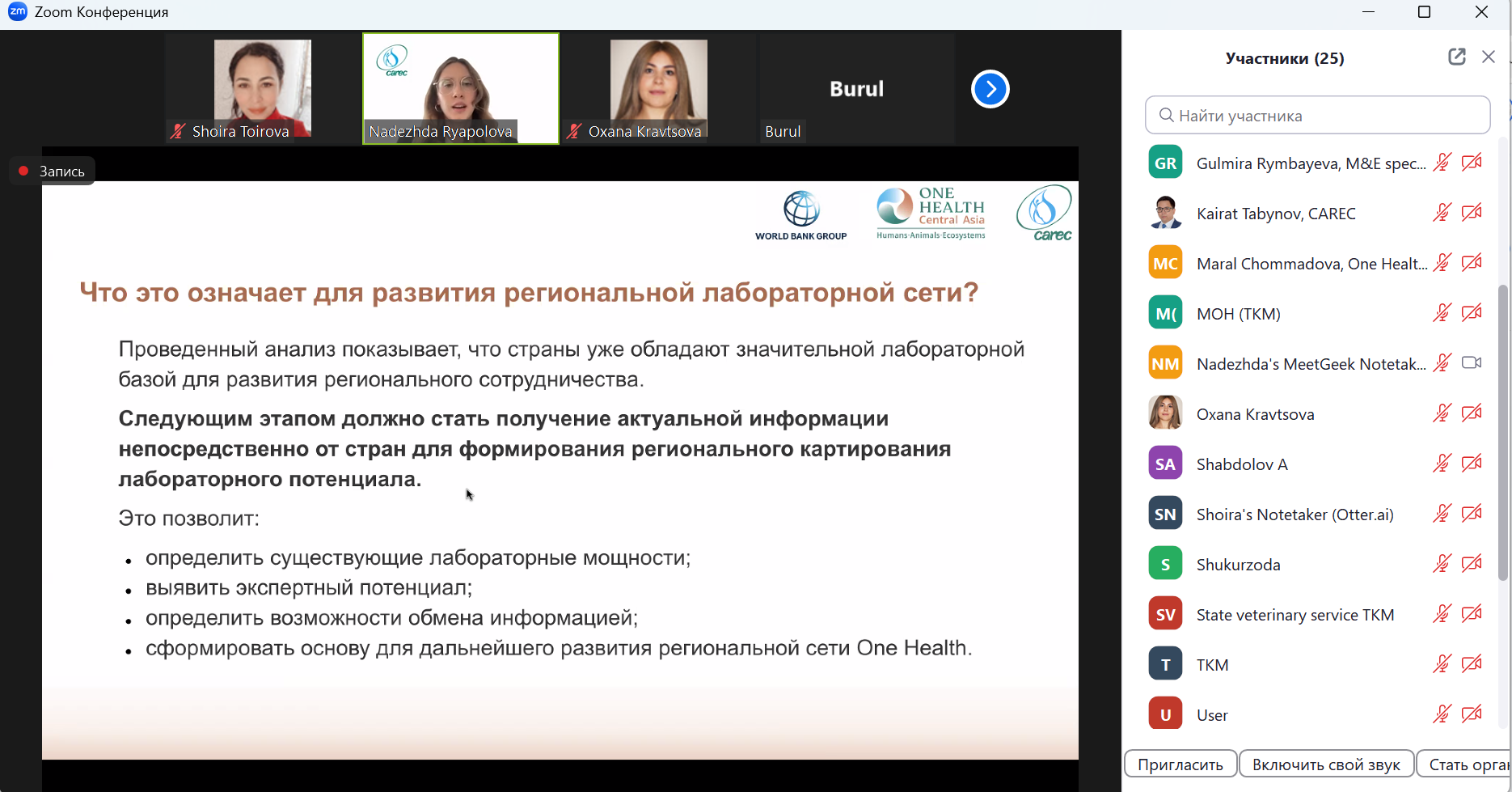
One of the proposals was to leverage the expert potential of neighboring Central Asian countries more actively. A shared professional environment, similar systems, and existing working contacts can serve as a foundation for mutual peer-to-peer expert support.
Additionally, participants pointed out the need for more precise mapping of accredited laboratories. National registries may not always contain information on laboratories that received international accreditation outside their home country. To obtain a complete picture, it was proposed to gather up-to-date information through national accreditation bodies and the relevant ministries themselves.
Digitalization and System Interoperability
Special attention was paid to laboratory information systems and data exchange.
Participants noted that in many countries, the digitalization of laboratories remains insufficient, and existing systems are not always compatible. This hinders prompt data analysis and interaction between laboratories, sectors, and countries.
At the same time, creating a single digital system requires the involvement of authorized government bodies and must align with national legislation. Therefore, a viable direction for regional efforts could be the development of coordinated technical procedures, data requirements, and interoperability mechanisms, rather than creating a single shared system [1].
A similar approach was proposed regarding laboratory equipment. Participants discussed the possibility of developing common technical requirements to improve the compatibility of equipment and consumables in future procurement cycles.
The Main Resource: Specialists
The meeting participants agreed that the sustainability of laboratory systems directly depends on human resource capacity.
Priority areas for specialist training include quality management systems, modern laboratory diagnostic methods, biosafety and biosecurity, data management, sequencing, and bioinformatics.
A regional format could help consolidate existing expertise, facilitate joint training sessions, promote knowledge sharing, and enable practical exercises. Strong reference laboratories within the region are capable of playing a more active role in capacity building and professional development for specialists from neighboring countries.
The Regional Secretariat of the One Health Program will continue to collect and systematize information. The work of the Technical Working Group is expected to help transition from isolated national laboratory systems and bilateral professional contacts to a more sustainable regional network—equipped with clear cooperation mechanisms, compatible approaches, trained specialists, and the ability to respond more rapidly to shared biological threats.
The meeting of the Technical Working Group marked the first stage of this effort. The next step is to translate the regional analysis into a concrete strategy and practical cooperation mechanisms.
Shoira Toirova, PR Specialist, One Health Program
[1] The ability of different systems to exchange data and understand each other.