

The regional methane conference in Ashgabat brought together government representatives, international organizations, and industry experts to discuss methane monitoring, mitigation, and regional cooperation. Aaron Feng, Senior Manager of Energy Transition at EDF, shares his reflections on the discussions, key challenges, and opportunities for advancing methane reduction efforts across Central Asia.
— What were some key takeaways for you from the Ashgabat conference?
Across country dialogues, it became clear that methane management cannot sit in a silo. Effective execution requires close, operational alignment between Energy Ministries (driving field operations), Environmental Regulators (overseeing GHG reporting, national inventory management, and MARS responses), and Finance Ministries (managing sovereign budget allocations and debt ceilings).
Presenting our 2024–2025 MethaneSAT basin-wide data revealed a potential 6.93 BCM of total annual measured methane leakage across the Amu Darya and South Caspian basins in Turkmenistan and Uzbekistan. For Turkmenistan alone, this represents roughly $1.65 billion in potential gas savings and export value. Framing methane mitigation through the lens of captured export value or domestic gas sales (in Uzbekistan’s presentation) and asset efficiency profoundly shifts the conversation with National Oil Companies by turning environmental compliance into a commercial upside, especially during the current high energy cost market.
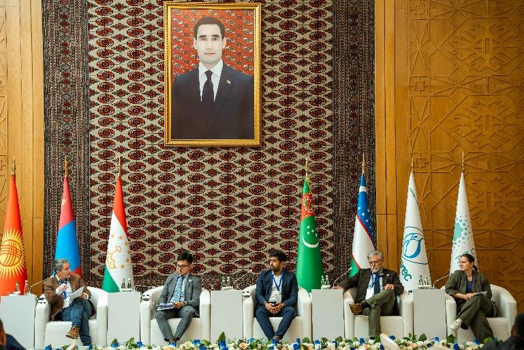
As highlighted by stakeholders such as Uzbekistan country leads, transitioning from calculation-based inventories to measurement-based MRV—supported by pilots like the World Bank's—is the foundational prerequisite for accurate enforcement, target-setting, and capital mobilization.
— Why was it important to have these conferences, particularly in-person?
In-person engagement in Ashgabat gave us the opportunity to exchange ideas directly and transparently, creating crucial space for genuine discussions on satellite data and analyses, the topics that can sometimes carry sensitivity or initial skepticism regarding data accuracy. and to build long-term trust and alignment.
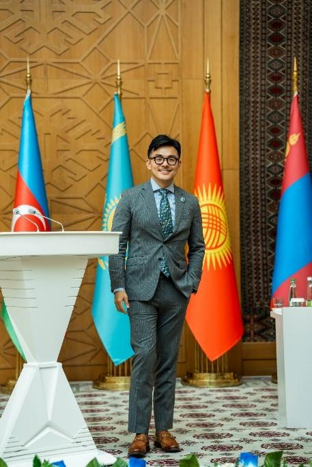
Bringing together diverse stakeholders, from EDF, CATF, UNEP IMEO, CCAC, and Carbon Mapper to regional NOC subject matter experts and technical service providers like Turkmen Gala, creates an environment where shared regional challenges can be openly debated and matched with practical engineering solutions. These gatherings serve as essential steppingstones to connect national roadmaps with broader international frameworks, feeding directly into engagements at COP31.
Beyond the formal sessions, the human element of in-person diplomacy in a country like Turkmenistan is irreplaceable. I was overwhelmed by the hospitality of local people- our airport driver even invited us to join a local wedding. Also, the experience meeting colleagues across Central Asia in-person and discovering our shared background and values. These personal connections are something that can't be replicated through virtual meetings
— What are your hopes for future dialogues and regional cooperation in Central Asia?
For future dialogues and regional cooperation, I would love to see a growing platform effect, including enhancing frameworks like CAREC’s ReCATH (Regional Climate Action Transparency Hub) and the Caspian Methane Emissions Accelerator to coordinate government and industry collaboration on experience sharing and others.
Moreover, I would love to get more progress updates on what a local stakeholder shared during the first day of the conference re: setting up regional technology hub next year. I would love to see how we can leverage the hub to address the non-market barriers for international technology sharing and build local technology service capacity across Central Asia.
Finally, I resonated with the Uzbek regulator’s presentations on shifting regional focus from traditional capacity-building outputs to verified, outcome-based KPIs tied directly to actual emission reductions, transparent repair financing, and harmonized regulatory frameworks. I would love to see how we can operate that in future dialogues.
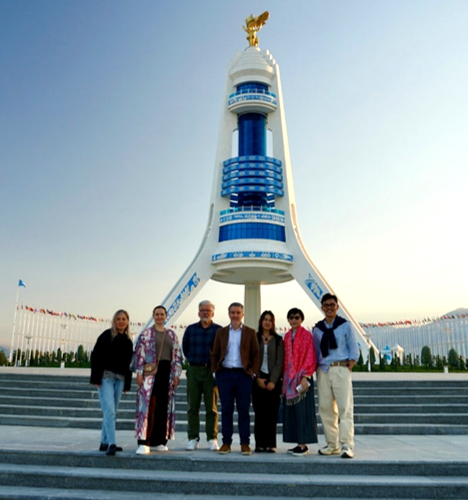
Photo: CAREC & International Partners at the Monument of Neutrality, Ashgabat, Turkmenistan
— What is EDF, and what are your core interests in Central Asia?
At the Environmental Defense Fund, we are “finding the ways that work.” We work in our four anchor regions: China, Europe, India, and the United States, and have reached globally in over 30 countries to address the world’s most important environmental challenges. We advance practical, science-based solutions to reduce emissions across the energy system and accelerate the transition to a low-carbon energy future. We pioneered methane science and advocacy first in the United States more than a decade ago and have since grown our work globally in partnership with governments, industry, and civil society.
In Central Asia, our interest centers on helping major gas-producing countries and national oil companies improve Measurement, Reporting, and Verification (MRV), enhance national inventory management, and bridge the gap between measurement data and bankable investment pipelines. We want to support technical capacity-building by sharing our international experience and addressing access-to-financing constraints by bringing innovative capital solutions to fund methane abatement. Ultimately, EDF aims to support Central Asian nations in scaling up and accelerating their methane mitigation actions.
Prepared by Jackie Erlon-Baurjan, Program Specialist, Climate Change and Sustainable Energy Program, CAREC, jerlonbaurjan@carececo.org
About the Project
The project "Capacity Building for Methane Emission Reduction in Central Asia" (CA CBMER) is implemented by the Regional Environmental Centre for Central Asia (CAREC) with financial support from the Global Methane Hub (GMH). It aims to strengthen the capacity of Central Asian countries to reduce methane emissions in the oil and gas sector by supporting the development of robust methane emission inventories and monitoring systems, and by fostering regional cooperation for the exchange of knowledge and experience.
The Global Methane Hub is a large-scale philanthropic initiative established in 2021 to coordinate and accelerate global efforts to reduce emissions of methane, which accounts for about 45% of recent net global warming. The organization acts as a key funder, convener and advocate of international initiatives, helping countries and organizations achieve the goals of the Global Methane Pledge. Its core mission is to support governments, civil society, the scientific community, non-profit organizations and the private sector in developing and implementing strategies to cut global methane emissions by at least 30–45% by 2030.
Additional information:
Dilovarsho Dustzoda – Project Manager, ddustzoda@carececo.org
Arailym Shulgauova – Project Specialist, ashulgauova@carececo.org
#ReCATH #CA_CBMER #methane #CAREC #CAREC_news #climate #climatefinance #MRV