

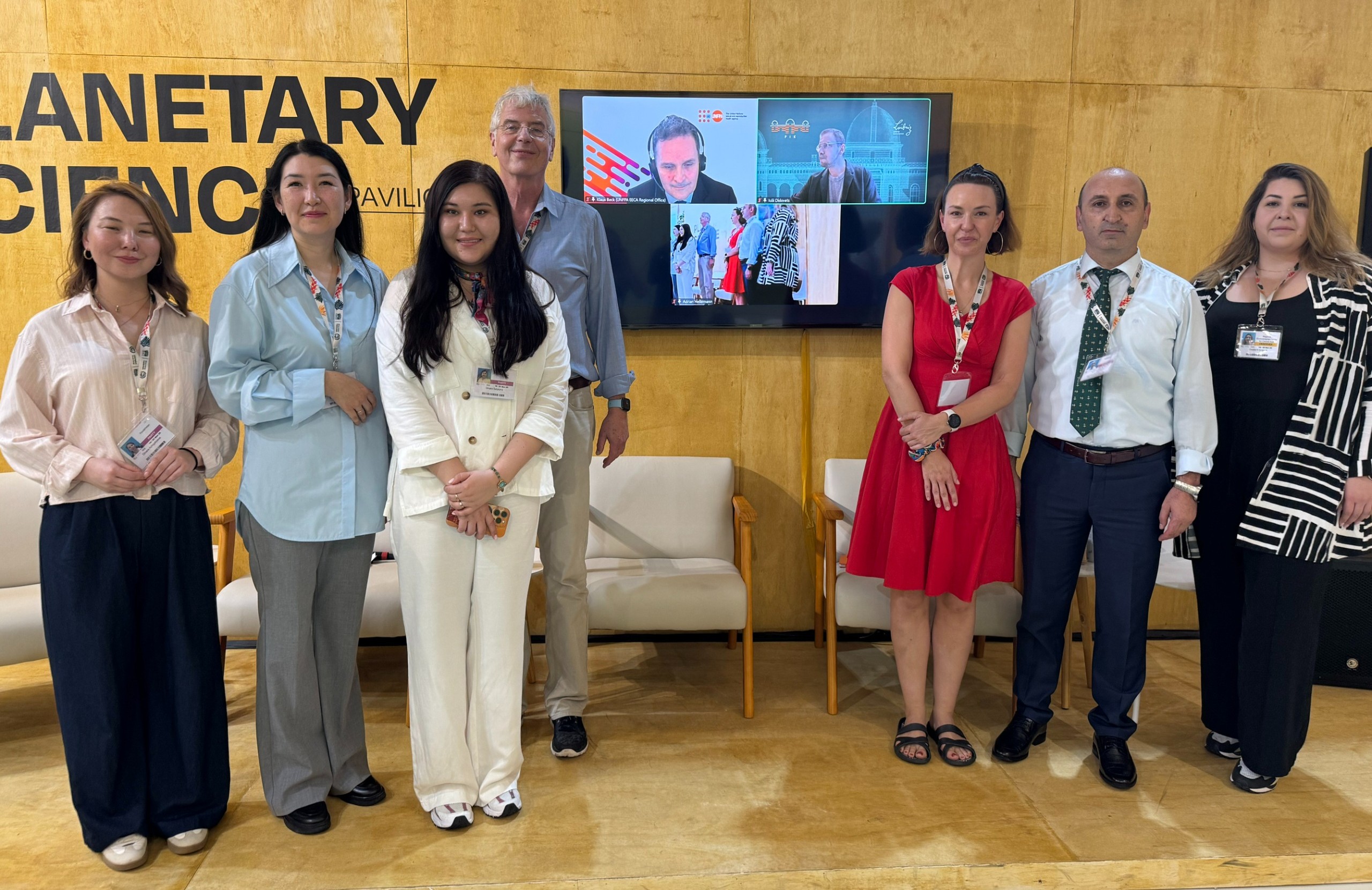
Belém – Brazil – November 18, 2025 – A thematic event dedicated to the strategic nexus between climate change, public health, and labor productivity in Central Asia was held on the sidelines of the 30th Conference of the Parties (COP-30) to the UN Framework Convention on Climate Change (UNFCCC).
The side event, titled “Climate Change, Health and Productivity Loss in Central Asia,” was organized by the Ministry of Ecology and Natural Resources of the Republic of Kazakhstan, the Central Asia Climate Foundation (CACF), the United Nations Population Fund (UNFPA), and leading research institutes – the Potsdam Institute for Climate Impact Research (PIK) and the Heidelberg Institute of Global Health (HIGH).
In her welcoming remarks, Dianara Azhigaliyeva, Deputy Head of the Central Asia Climate Foundation (CACF), noted that Central Asia is among the world’s most vulnerable regions to climate warming, which is already having a direct impact on public health, economic resilience, and social stability. She also emphasized the necessity of integrating health, climate adaptation, and social resilience issues into national climate strategies, Nationally Determined Contributions (NDCs), and National Adaptation Plans (NAPs).
The Climate-Health-Productivity Nexus: Scientific Evidence and Challenges
Experts from PIK, HIGH, and UNFPA presented scientific data confirming the impact of extreme heat and climate change on health, labor productivity, and gender inequality:
● Rising heat stress leads to an increase in cardiovascular, respiratory, and mental health disorders.
● Informal workers, women, the elderly, and rural populations are emerging as particularly vulnerable groups.
● Extreme heat shortens working hours and reduces productivity, specifically in the agriculture and construction sectors.
● Women and girls, especially in rural areas, face a double burden: heightened health risks combined with reduced access to services.
UNFPA representatives stressed the need to include sexual and reproductive health issues, as well as maternal and neonatal risks, in climate strategies (NAPs, NDCs), taking into account the specific impact of heat on the health of women and newborns.
One Health: Human, Animal, and Ecosystem Health as a Unified System
In her speech, Oxana Kravtsova, Manager of the “Environment and Health” Program at the Regional Environmental Centre for Central Asia (CAREC), presented the regional One Health approach, emphasizing that resilience to climate change begins with ecosystem resilience. She noted that Central Asia is already facing escalating climate risks: pasture degradation, biodiversity loss, increasing water stress, a rise in vector-borne and zoonotic diseases, and the loss of natural barriers that protect against disease spread.
“Climate change is not just an environmental problem. It is a challenge to our health, food security, and social resilience. Human health is impossible without ecosystem health,” emphasized Oxana Kravtsova.
Special emphasis was placed on CAREC's role as the Regional Secretariat for the One Health approach, uniting environmental, health, agricultural, and veterinary agencies of the five Central Asian countries.
In July 2025, at the first Regional One Health Conference coordinated by CAREC, the Regional One Health Coordination Council (ROHCC) was established. It is the region's first intergovernmental body bringing together high-level representatives from key ministries to jointly develop strategies, exchange data, respond to cross-border threats, and prepare joint applications for international funding, including the Pandemic Fund.
The role of the Council includes:
● Developing a Regional One Health Action Plan;
● Creating a unified regional data system and online portal;
● Coordinating interdepartmental working groups;
● Documenting and scaling up best practices;
● Facilitating joint access to climate and health finance.
Regional Cooperation as the Foundation of Resilience
Participants noted that Central Asian countries are demonstrating a readiness to move from recognizing threats to joint action. This requires:
● Creating a regional platform on climate, health, and productivity;
● Pooling scientific, political, and financial resources;
● Scaling digital tools for monitoring health and ecosystems;
● Launching regional projects on Nature-based Solutions (NbS) and biodiversity protection.
Contact Information:
Oxana Kravtsova Manager, “Environment and Health” Program, CAREC okravtsova@carececo.org