

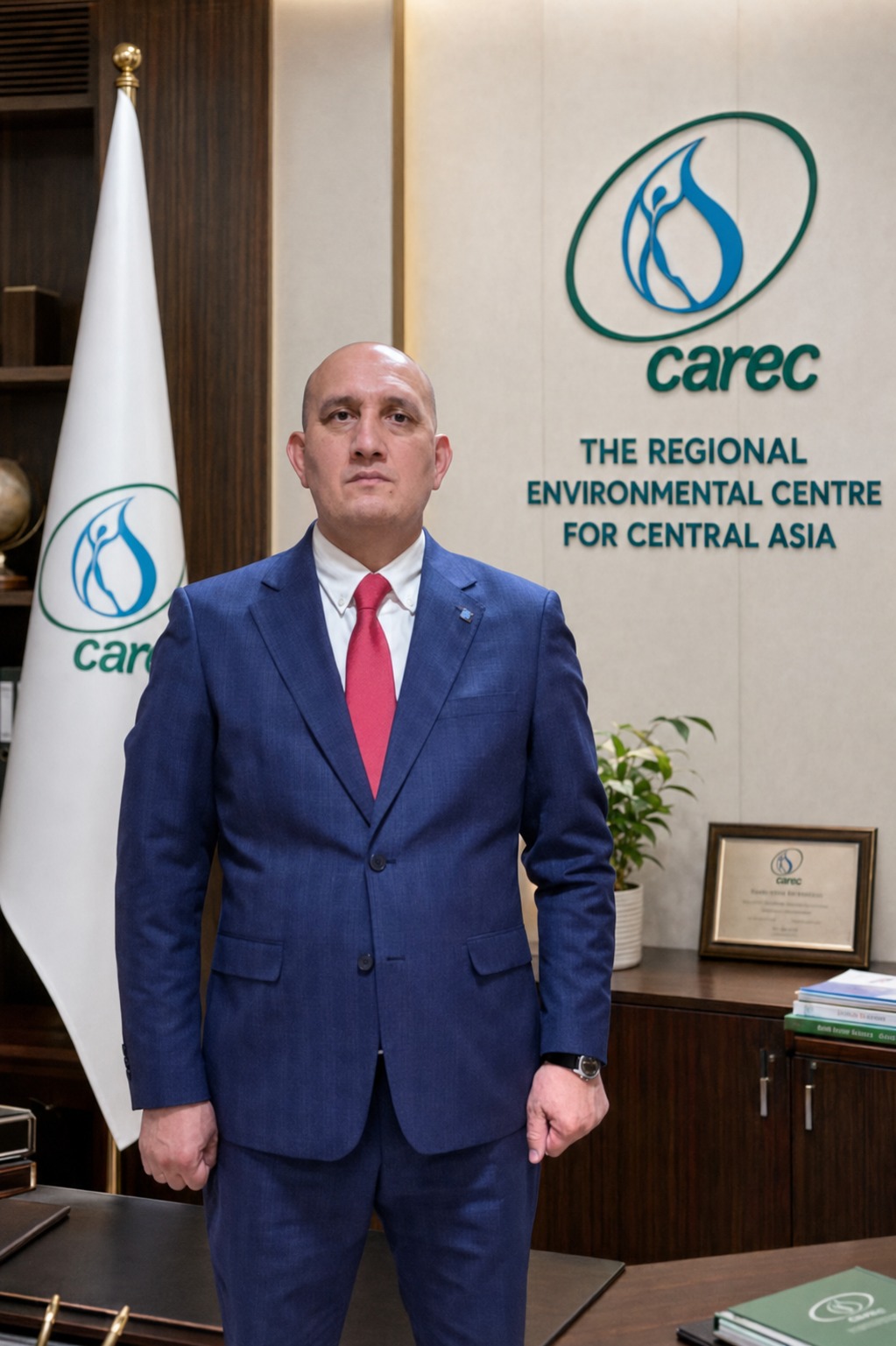
Mergen Kepbanov Director of the CAREC Project Office
in Turkmenistan turkmenistan@carececo.org
Abstract
This article examines the role of the Ministry of Environmental Protection of Turkmenistan (MEP) in the state environmental monitoring system. Particular attention is given to the Ministry’s mandate and the activities of organizations within its system: the Environmental Control Service, territorial environmental protection departments, the Caspian Environmental Control Service (“Khazar Environmental Control”), the Hydrometeorological Service, forestry enterprises, and state nature reserves. The article addresses monitoring of ambient air, surface waters, the marine environment of Turkmenistan’s sector of the Caspian Sea, climate and the ozone layer, forests, flora and fauna, biodiversity, and sources of anthropogenic impact. It identifies problems associated with fragmented regulation and insufficient data integration. Proposals are substantiated for establishing a unified state environmental monitoring system, strengthening the coordinating role of the MEP, creating a unified information platform, and integrating data into the State Environmental Information Fund.
Keywords: environmental monitoring, state environmental monitoring, Ministry of Environmental Protection of Turkmenistan, environmental control, ambient air, surface waters, Caspian Sea, hydrometeorology, biodiversity, environmental information.
Introduction
The modern development of the oil and gas, chemical, energy, construction and other industries, transport, and housing and utilities infrastructure is increasing anthropogenic pressure on the environment. Under these conditions, public administration requires a continuously operating mechanism for obtaining objective data on the state of the natural environment, sources of impact, and the dynamics of environmental change. State environmental monitoring serves as such a mechanism.
Environmental monitoring has both scientific and information value and an important management function. It is based on observations, measurements, laboratory studies, and the collection, processing, and analysis of data, but its results are primarily intended to support decision-making. These functions include preventing pollution, planning environmental protection measures, controlling sources of impact, and informing stakeholders.
In Turkmenistan, monitoring is regulated by a body of environmental and natural-resource legislation. A special role is assigned to the MEP, which, under the Law “On Nature Protection,” is responsible for establishing the procedure for and organizing state monitoring of the environment and natural resources, as well as coordinating this activity [7]. Accordingly, this article is limited to the activities of the MEP and its subordinate organizations; the powers of other agencies are addressed only in the context of their interaction with the Ministry.
The purpose of the study is to systematize the legal foundations and practical areas of MEP monitoring activities, clarify the role of its specialized and territorial structures, and identify the principal directions for institutional and legal improvement.
Legal Status of the MEP as the Coordinator of Environmental Monitoring
The Law “On Nature Protection” defines state environmental monitoring as a comprehensive system of observations of the state of the environment, assessment of its condition, and forecasting of changes caused by natural and anthropogenic factors [7]. Monitoring therefore is not limited to a one-time measurement or inspection; rather, it constitutes a continuous information cycle.
Article 56 of the Law links monitoring with observation of the state of the environment, including areas subject to intensive anthropogenic impact, and with providing the state, legal entities, and individuals with reliable information necessary to prevent or reduce adverse consequences of environmental change [7]. Thus, monitoring performs preventive, informational, and management functions.
The MEP’s authority to organize and coordinate monitoring is of key importance. The Ministry is not merely one of the entities conducting observations; it is the central environmental protection body that should ensure methodological and organizational consistency of monitoring activities. Its mandate covers ambient air, surface waters, forests, flora and fauna, specially protected natural areas, the marine environment of the Caspian Sea, and sources of anthropogenic impact.
Environmental monitoring must be distinguished from environmental control. The former is primarily aimed at obtaining, accumulating, analyzing, and forecasting information; the latter at verifying compliance with mandatory requirements and applying response measures. In the activities of the Environmental Control Service, these functions closely interact: measurement results may provide a basis for control actions, while control materials supplement the monitoring information base.
Institutional Organization of Monitoring within the MEP System
Monitoring activities within the MEP system are distributed among specialized and territorial structures. This organization reflects the diversity of environmental objects, differences in observation methodologies, and the need for permanent territorial presence.
The Environmental Control Service (ECS) monitors pollution of ambient air, surface waters, and soils; observes emission and discharge sources; and carries out certain areas of control over the handling of industrial waste [12]. Its laboratory capacity gives its activities a measurement and analytical character.
Environmental protection departments of the velayats form the territorial level of the system. They conduct measurements, observe environmentally significant facilities, and transmit information to the MEP’s central structures [14]. This provides the monitoring system with regional coverage.
The specialized Caspian function is performed by the Khazar Environmental Control Service [13].
The hydrometeorological component is provided by the Hydrometeorological Service, which conducts observations of the atmosphere, climate, ozone layer, and hydrological processes [2; 3].
In the forestry sector, forestry enterprises play an important role, while state nature reserves perform a key role within specially protected natural areas.
Thus, a functionally differentiated model has developed within the Ministry: specialized services provide thematic monitoring, territorial departments provide spatial coverage, and relevant departments of the central administration provide sectoral management and information consolidation. The strength of this model is specialization; its vulnerability is the need for continuous integration of heterogeneous information flows.
Monitoring of Ambient Air and Pollution Sources
Monitoring of ambient air is among the most developed areas of MEP activity. The Law “On Protection of Atmospheric Air” treats it as a system of observations designed to obtain reliable information on air quality, pollution, and possible changes in its condition [8]. The organization and implementation of monitoring fall within the competence of the MEP.
The ECS and territorial environmental protection departments in the velayats compile lists of enterprises and organizations that are subject to observation. Monitoring covers emissions of pollutants into the atmosphere and, in relation to the integrated impact of enterprises, also surface waters, soils, and the storage of hazardous industrial waste [12; 14].
The ECS includes an ambient air pollution assessment laboratory. According to the material analyzed, sampling and chemical analysis are carried out at 12 stationary monitoring stations in six major cities: four in Ashgabat; two each in Dashoguz, Turkmenabat, and Turkmenbashi; and one each in Mary and Balkanabat. Samples are collected three times a day, except on Sundays.
The observation program includes dust, nitrogen dioxide and nitrogen oxide, sulfur dioxide, phenol, and formaldehyde. Territorial departments conduct observations in velayat centers using a similar set of indicators. Information is transmitted to the ECS, where it is consolidated and used to prepare a daily ambient air quality bulletin.
Monitoring vehicle emissions is another important area. The ECS uses mobile laboratories and gas-analysis equipment, while territorial departments conduct measurements at the most vulnerable urban locations. Equipment upgrades and specialist training improve the responsiveness and technical capacity of the system.
Thus, ambient air monitoring combines stationary observations, mobile measurements, pollution-source control, and centralized information processing. This area can serve as an organizational model for further digitalization of other MEP subsystems.
Monitoring of Surface Waters
The Water Code assigns the MEP responsibility for monitoring surface water quality [1]. Within the Ministry, this function is primarily assigned to the ECS. Its subject is the environmental quality of the aquatic environment, distinguishing MEP activities from accounting for water quantity and the economic regulation of water use.
The observation system covers rivers, canals, reservoirs, and lakes. Local units conduct rapid measurements of individual physical and chemical parameters, while the ECS central laboratory performs more complex analyses of major ions, nutrients, organic pollutants, and organochlorine pesticides.
Surface-water monitoring is closely linked to control of special water-use conditions, wastewater discharge, and the operation of treatment facilities. Therefore, observation results are directly relevant to identifying pollution sources and selecting government response measures.
A prospective task is to combine environmental water-quality control results with hydrological and other data in a unified information environment, while preserving the MEP’s independent environmental protection mandate.
Monitoring of Turkmenistan’s Sector of the Caspian Sea
The Caspian Sea is an environmentally sensitive area where marine and coastal ecosystems, oil and gas activities, port infrastructure, transport, and recreational use of the coastline intersect. Therefore, a specialized Caspian Environmental Control Service operates within the MEP system.
The Service monitors Turkmenistan’s sector of the Caspian Sea and the two-kilometer coastal zone, analyzes wastewater composition, controls marine-water and ambient-air quality, and observes the economic activities of coastal enterprises [13].
The Service has an environmental monitoring laboratory and a hydrochemical laboratory. Observations cover Garabogaz, the Turkmen Bay, Kiyanly and Ekerem bays, offshore drilling areas, Turkmenbashi Bay, and the Avaza recreational zone. Sampling frequency varies depending on the environmental significance of each site.
In seawater, temperature, pH, dissolved oxygen, biochemical oxygen demand, oxidizability, salinity, chlorides, nitrites, ammonium nitrogen, sulfates, iron ions, and suspended solids are determined. In parallel, ambient air is monitored in Turkmenbashi, including dust, nitrogen oxides, sulfur dioxide, and hydrogen sulfide.
The Service interacts with oil and gas companies operating in the Caspian Sea, including in surface-water monitoring. Such interaction expands the information base; however, state monitoring must retain the independence of assessment and the ability to verify production data provided by natural-resource users.
The Caspian subsystem demonstrates the advantages of subject-specific specialization: the characteristics of the marine environment require their own observation network, laboratory capacity, and methodologies. This experience should be taken into account in developing monitoring of other environmentally vulnerable territories.
Hydrometeorological Monitoring, Climate and the Ozone Layer
The MEP Hydrometeorological Service provides the observation component associated with atmospheric conditions, meteorological and hydrological conditions, climate, and other natural processes [2]. Its data are fundamental to environmental assessment because they make it possible to account for natural variability when analyzing anthropogenic impacts.
A specialized area is ozone-layer monitoring. The Hydrometeorological Service observes, assesses, and forecasts changes in the ozone layer over the territory of Turkmenistan [3]. Tasks include measuring the state of the ozone layer and near-surface ultraviolet radiation, maintaining a data bank, providing information to government bodies, and participating in international data exchange.
The Ministry operates an Ozone Center, which performs coordination and information functions within measures to reduce consumption of ozone-depleting substances, including data collection and processing and preparation of reporting materials.
Under conditions of climate change, the value of hydrometeorological observation series is increasing. For the MEP, these data should be used not only as standalone information but also as an analytical basis for interpreting data on pollution and the condition of water resources, forests, and biodiversity.
Forest Monitoring
The Forest Code provides for forest monitoring to ensure effective management, use, reproduction, conservation, and protection of forests [11].
Forestry enterprises conduct primary observations of the condition of stands, regeneration, greening, conservation, and protection of forests. Based on monitoring results, they report quarterly to the MEP Forestry Department.
An important complement to ongoing monitoring is the state forest inventory. The National Forest Programme of Turkmenistan for 2026–2030 provides for a five-year inventory cycle.
Monitoring and inventory should be viewed as complementary instruments: the former records dynamics, while the latter provides a periodic comprehensive snapshot. Integrating them into a digital information system would improve the quality of forest-resource management.
Monitoring of Biodiversity, Flora and Fauna
Monitoring of flora is aimed at timely identification of changes, their assessment, and prevention of negative processes [5]. Fauna monitoring covers the distribution, abundance, and condition of animals and the characteristics of their habitats [6].
Monitoring within specially protected natural areas is of particular importance to the MEP. Its traditional form is the Chronicle of Nature, a system of long-term observations by scientific units of nature reserves of the condition of ecosystems and natural objects [4].
Biodiversity monitoring is conducted in nine state nature reserves, and information is submitted monthly to the MEP Department of Flora and Fauna. This creates a basis for centralized assessment of protected ecosystems. The Chronicle of Nature has particular scientific value: long-term observation series make it possible to identify changes in populations, seasonal processes, and habitats that cannot be detected through one-time surveys. Under climate change, the value of such data increases substantially.
A promising approach is to integrate data from nature reserves, forestry enterprises, and monitoring of individual species into a unified biodiversity subsystem. This would enable a transition from fragmented observations to ecosystem-level assessment and improve the quality of conservation planning.
Monitoring of Game Resources and Their Habitats
The Law “On Hunting and Protection of Game Resources” defines monitoring of game resources as a system of observations conducted to timely identify changes in the condition of game resources and the habitats of game species, assess such changes, and prevent and eliminate negative processes and their harmful consequences.
The structure and content of game-resource monitoring and the procedure for its implementation are established by the MEP.
Monitoring of the condition of game species and their habitats is carried out in hunting enterprises by their managers and in hunting grounds by their users (Article 47) [10].
Managers of hunting enterprises are required to conduct systematic monitoring of game species and the condition of their habitats within the territory of the hunting enterprise (Article 39, Part 2, paragraph 2) [10].
Information Flows and the State Environmental Information Fund
The effectiveness of monitoring is determined not only by the quantity of measurements but also by the organization of information flows. Within the MEP system, a vertical model can be observed: territorial departments transmit data to specialized services; forestry enterprises to the relevant department; nature reserves to the Department of Flora and Fauna; and ambient-air monitoring stations to the ECS.
Such a vertical structure ensures departmental manageability but does not guarantee cross-functional integration. Data on air, water, the marine environment, forests, and biodiversity are generated by different units, using different methodologies and at different frequencies. Without a unified information core, there is a risk of parallel datasets that complicate comprehensive environmental assessment.
The Law “On Environmental Information” provides for a State Environmental Information Fund under the authority of the MEP [9]. At present, such a Fund has not yet been established. Its creation could become a major institutional step toward integrating monitoring data.
The Fund should be designed as a modern digital system containing not only final reports but also structured time series, spatial data, information on methodologies, sampling locations, and measurement quality. This would make monitoring information useful for trend analysis, forecasting, and preparation of management decisions.
The public-information function of monitoring is equally important. The legislative objective includes providing legal entities and individuals with reliable information on the state of the environment [9]. Accordingly, aggregated and verified data should become part of the environmental information system available to the public.
Key Challenges in the Operation of Monitoring within the MEP System
The first problem is insufficient integration of monitoring information. Specialized structures are capable of generating substantial volumes of data; however, without a unified digital platform, their comparison, comprehensive assessment, and operational use are difficult.
The second problem is the need for unified reporting forms and classifiers. Effective centralization requires standardized formats, data-submission frequency, verification rules, and metadata that make it possible to establish the origin and methodology of each indicator.
The third problem concerns the combination of monitoring and control functions. This is practically justified but requires procedural delineation: monitoring should ensure the objectivity of observations, while control should provide a legal assessment of compliance with mandatory requirements.
The fourth problem is technical and laboratory capacity. Developing the observation network requires modern equipment, mobile laboratories, regular verification and calibration of instruments, unified methodologies, and continuous professional development of specialists.
The fifth problem is the insufficient development of analytical and forecasting components. The legislative concept of monitoring includes not only observation but also assessment and forecasting. Accordingly, future development should include trend analysis, spatial modeling, and environmental risk assessment.
Key Areas for Improving the Activities of the MEP
It would be advisable to establish a specialized unit within the MEP central administration responsible for integrating monitoring data. It should not duplicate the ECS, Hydrometeorological Service, or Khazar Environmental Control Service; its task should be centralized collection, verification, analysis, storage, and preparation of integrated assessments.
A unified state environmental monitoring information platform is required to provide electronic data transmission, standardized formats, automated completeness checks, spatial visualization, and generation of time series. The platform should be technologically linked to the State Environmental Information Fund.
A unified quality-assurance system for laboratory data should be developed, including standardized sampling and analytical methods, equipment calibration, interlaboratory comparisons, electronic recordkeeping, and staff training.
The observation network should be modernized on the basis of environmental risk, taking into account the concentration of industrial sources, transport load, vulnerability of water bodies, population density, specially protected areas, and prospects for economic development.
The forecasting function of monitoring must be strengthened. MEP management should receive not only primary indicators but also environmental quality indices, pollution maps, trend assessments, and environmental risk forecasts.
Monitoring results should be systematically used in developing environmental programs, conducting environmental impact assessment and audits, issuing permits, determining inspection priorities, and assessing the effectiveness of environmental protection measures.
Within the requirements of legislation, public presentation of aggregated data on ambient-air quality, surface and marine waters, forests, and biodiversity should be expanded. This is consistent with the information function of state monitoring and contributes to greater confidence in environmental data.
Proposed Model of an Integrated Departmental Monitoring System
Based on the analysis, four levels of an integrated MEP monitoring system can be identified.
The first level is primary observation: stationary stations, mobile laboratories, sampling points, hydrometeorological stations, forestry enterprises, and nature reserves. This is where raw data are generated.
The second level is specialized processing. The ECS, Hydrometeorological Service, Khazar Environmental Control Service, relevant departments, and laboratories verify, process, and thematically analyze information within their respective mandates.
The third level is intra-departmental integration. A specialized unit within the MEP central administration should combine thematic datasets, ensure their interoperability, maintain a common database, and prepare integrated assessments of the state of the environment.
The fourth level is state and public use. Consolidated data are submitted to government authorities, used in environmental decision-making, incorporated into state reports and information resources, and, to the extent provided by law, made available to the public.
The advantage of this model is that it preserves the professional specialization of existing services while incorporating their data into a unified information cycle. Integration, rather than mechanical organizational merger, appears to be the most rational direction for modernization.
Conclusion
Thus, the MEP occupies a central position in the state environmental monitoring system of Turkmenistan. Its status is determined by the combination of direct monitoring powers with the function of organizing and coordinating the relevant activities.
The Ministry’s system has developed substantial institutional capacity. The ECS monitors ambient-air and surface-water pollution and sources of impact; territorial departments provide regional coverage; Khazar Environmental Control conducts specialized observations in Turkmenistan’s sector of the Caspian Sea; the Hydrometeorological Service generates hydrometeorological, climate, and ozone-monitoring data; forestry enterprises participate in forest monitoring; and nature reserves conduct long-term observations of biodiversity and ecosystems.
The strength of the model is subject-specific specialization; however, the diversity of subsystems simultaneously creates a need for their information integration.
A modern system should evolve from a collection of specialized observations into a unified information and analytical mechanism.
This requires a unified environmental monitoring system, dedicated legislative regulation, stronger coordinating powers for the MEP, an analytical and information unit, a digital platform, and a State Environmental Information Fund.
Comprehensive environmental monitoring represents a management cycle: observation — measurement — verification — accumulation — analysis — forecasting — information provision — decision-making — outcome evaluation. The extensive network of specialized and territorial MEP organizations provides an institutional basis for establishing such a cycle.
Developing monitoring within the MEP system can enhance the scientific basis of state environmental policy, the responsiveness of pollution and environmental-risk management, the quality of environmental decisions, and access to reliable environmental information. Therefore, improving environmental monitoring should be regarded as one of the key areas for strengthening the environmental security of Turkmenistan.
References and Regulatory Sources
1. Water Code of Turkmenistan. Approved by Law of Turkmenistan dated 15 October 2016 // Bulletin of the Mejlis of Turkmenistan. 2016. No. 4. Art. 139.
2. Law of Turkmenistan “On Hydrometeorological Activities” dated 30 March 2024.
3. Law of Turkmenistan “On Protection of the Ozone Layer” dated 15 August 2009 // Bulletin of the Mejlis of Turkmenistan. 2009. No. 3. Art. 54.
4. Law of Turkmenistan “On Specially Protected Natural Areas” dated 31 March 2012 // Bulletin of the Mejlis of Turkmenistan. 2012. No. 1. Art. 37.
5. Law of Turkmenistan “On Flora” dated 4 August 2012 // Bulletin of the Mejlis of Turkmenistan. 2012. No. 3. Art. 60.
6. Law of Turkmenistan “On Fauna” dated 2 March 2013 // Bulletin of the Mejlis of Turkmenistan. 2013. No. 1. Art. 4.
7. Law of Turkmenistan “On Nature Protection” dated 1 March 2014 // Bulletin of the Mejlis of Turkmenistan. 2014. No. 1. Art. 40.
8. Law of Turkmenistan “On Protection of Atmospheric Air” dated 26 March 2016 // Bulletin of the Mejlis of Turkmenistan. 2016. No. 1. Art. 51.
9. Law of Turkmenistan “On Environmental Information” dated 14 March 2020 // Bulletin of the Mejlis of Turkmenistan. 2020. No. 1. Art. 3.
10. Law of Turkmenistan “On Hunting and Management of Hunting Resources” dated 18 December 2021 // Bulletin of the Milli Gengesh of Turkmenistan. 2021. No. 4. Art. 145.
11. Forest Code of Turkmenistan. Approved by Law of Turkmenistan dated 25 March 2011 // Bulletin of the Mejlis of Turkmenistan. 2011. No. 1. Art. 10.
12. Regulation on the Environmental Control Service of the Ministry of Environmental Protection of Turkmenistan, approved by Order No. 19-ö of the Minister of Environmental Protection of Turkmenistan dated 5 August 2023.
13. Regulation on the Khazar Environmental Control Service of the Environmental Protection Service of the Ministry of Environmental Protection of Turkmenistan, approved by Order No. 25-ö of the Minister of Environmental Protection of Turkmenistan dated 15 August 2023.
14. Regulation on the Environmental Protection Department of Lebap Velayat of the Ministry of Environmental Protection of Turkmenistan, approved by Order No. 301-ö of the Minister of Environmental Protection of Turkmenistan dated 10 December 2024.