

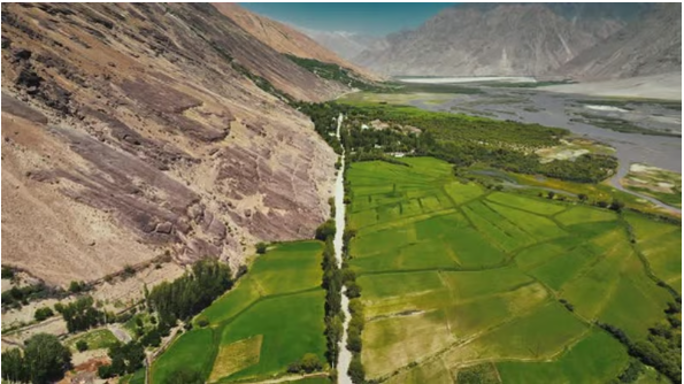
1. Aerial view of the Pamir Mountains, Tajikistan. Source: By DELOZA
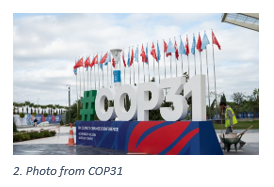
Cross-border environmental cooperation is being discussed across all 159 pavilions at the 2026 UN Climate Change Conference (COP31). Held in the Turkish city of Antalya, the summit has become a massive, bustling workspace for nearly 100,000 participants from 196 countries and the European Union—from heads of state, diplomats, and scientists to business leaders, environmental activists, and journalists.
Behind the calls for cross-border cooperation lies not routine diplomacy, but a simple reality: climate, rivers, mountain ranges, and wildlife migration routes do not recognise national borders.
International donors and financial institutions understand this well. They are increasingly setting up dedicated support mechanisms—regional grant windows and concessional credit lines—open exclusively to joint initiatives involving multiple countries. The logic is entirely pragmatic, as pooling efforts delivers clear benefits to everyone involved:
- Countries gain access to specialised regional funds closed to single-country applications and save their own budgets by adopting shared methodologies and monitoring systems instead of building them from scratch.
- Coordinated action with neighbours protects roads, irrigation canals, and farmland from losing value, because a cross-border mudslide, flood, or wildfire cannot be stopped at a border checkpoint.
- When states agree to jointly manage shared resources, the risk of conflict drops, and the entire region becomes a clearer, more predictable market for major investors, while the broader world benefits from preserved global ecosystems.
In practice, however—from major river basins in Southeast Asia and Latin America to mountain systems in Europe and the Caucasus—this process repeatedly runs into the same systemic bottleneck. At the negotiation table, countries find common ground easily enough, yet even drafting framework declarations often turns into a slow and complicated process. Heavy workloads and staff turnover make it hard to keep permanent representatives from line agencies in a single working group. In neighbouring countries, different ministries often handle the exact same issues, while differences in national terminology and legal procedures become major hurdles during drafting. As a result, even a framework document has to go through lengthy rounds of interagency reviews in every participating country.
Yet even after all signatures are finally in place, moving to actual work brings the next challenge. In international practice, this is known as the "implementation gap": without shared technical standards, comparable databases, and aligned investment plans among neighbours, even the most promising agreements risk staying on paper.
Central Asia is no exception. Countries in the region regularly reaffirm their commitment to the climate agenda and combating land degradation, yet the central question of recent decades has been how to translate that political will into working tools for cross-border action.
The experience of the World Bank's Resilient Landscapes in Central Asia programme (RESILAND CA+) is an effort to build just such a practical model—moving forward step by step through harmonised rules, unified information systems, and joint investment plans.
Why National Efforts Alone Are Not Enough
Central Asia is already facing a growing set of climate and natural threats—from rising temperatures and melting glaciers to droughts, wildfires, mudslides, and floods. According to World Bank estimates, land degradation costs the region’s economy an average of around 6% of GDP every year. Behind this figure lie tangible losses: depleted farmland, falling rural incomes, and rising state budget spending on disaster recovery.
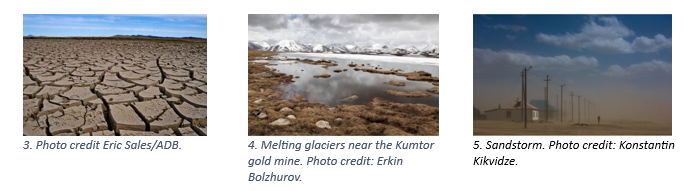
At the same time, mountain ecosystems, river basins, and forests span across multiple states, making it impossible to ensure their long-term resilience through national measures alone. The region needs an architecture where each country’s domestic reforms are naturally reinforced by coordinated work with its neighbours.
From Declarations to Action: The RESILAND CA+ Algorithm
To bridge the gap between political statements and real-world practice, the regional component of the RESILAND CA+ programme—implemented with the support of the Regional Environmental Centre for Central Asia (CAREC)—is building a step-by-step framework. This approach helps countries dismantle legal, informational, and financial barriers one stage at a time.
Step One: Agreeing on Rules Without Compromising Sovereignty
Any regional cooperation stalls if line agencies in neighbouring countries lack a common language and clear rules of engagement. To get things moving, relevant government bodies across all five Central Asian states—supported by the programme—developed a package of six interconnected regional documents covering key areas of landscape management:
- Nature-based Solutions (NbS). Introducing ecological approaches to restore degraded land and strengthen ecosystem resilience.
- Fire Management. Developing a shared regional system for wildfire prevention and monitoring.
- Biodiversity Conservation. Strengthening cooperation to protect rare species and exchange up-to-date environmental data.
- Protected Areas. Jointly tackling wildfires, invasive species, and other cross-border threats.
- Transboundary Conservation. Advancing coordinated management of border ecosystems and wildlife migration corridors.
 Sustainable Tourism. Supporting the growth of environmentally responsible nature tourism.
Crucially, these documents neither replace national legislation nor limit state sovereignty. Instead, they establish a foundation for voluntary cooperation tailored to each country’s priorities and institutional capacity.
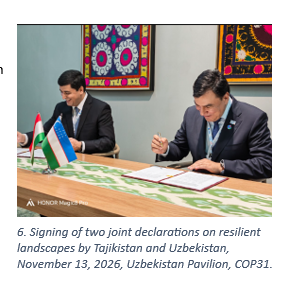
Practical proof that this approach works came when the Republic of Tajikistan and the Republic of Uzbekistan signed the first two documents in the package: Joint Declarations of Intent on Nature-based Solutions and on Wildfire Prevention. National review and approval procedures are now underway in Kazakhstan, Kyrgyzstan, and Turkmenistan, which will expand the circle of participating countries once completed.
Step Two: Building a Unified Information Base and Managing Risks
Agreed intentions only begin to deliver results when government agencies rely on clear, comparable data. That is why the second pillar of the RESILAND CA+ regional component focuses on building a shared informational and analytical infrastructure:
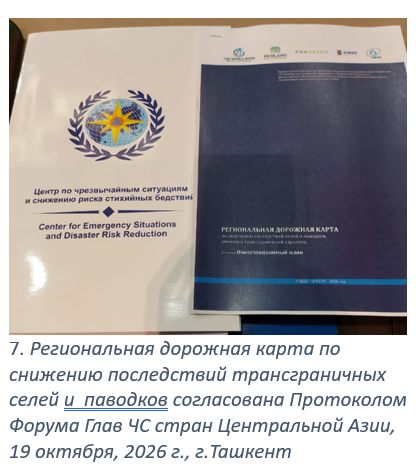 Developing the RESILAND CA+ Knowledge Portal. The platform is being populated with a regional landscape database and an online catalogue of transboundary mudslides and floods, giving line agencies access to proven methodologies and an up-to-date picture of natural risks across the entire region.
- Coordinated Disaster Planning. Countries have finalised and agreed upon a Regional Roadmap for Mitigating Transboundary Mudslides and Floods, alongside an accompanying Investment Plan. The roadmap sets out a clear mechanism for interagency coordination, while the investment plan outlines priorities for attracting technical and financial support.
Step Three: Turning Agreements into Real Actions
Signing regional declarations or endorsing roadmaps is not the finish line, but merely a starting point—documents alone do not guarantee an automatic flow of funding into the region.
However, once countries have agreed on common standards, set up data-sharing systems, and defined cross-border priorities, they gain a solid foundation for preparing joint investment projects that make sense to international financial institutions and donors. The main challenge of the upcoming phase is to turn these signed papers into concrete on-the-ground activities, financing mechanisms, and joint implementation.
Ultimately, Central Asia’s resilience depends not only on how effectively each country acts within its own borders, but also on how well the region manages to pool its efforts.
 Author: Lyudmila Kiktenko – Environmental Management Programme Manager, Deputy Team Leader of the "Resilient Landscape Restoration in Kyrgyzstan: Regional Component" project, Regional Environmental Centre for Central Asia (CAREC). lkiktenko@carececo.org
 ********************************************************************************
To learn more about the themes and outcomes of the RESILAND CA+ programme —a flagship World Bank initiative supporting national programmes for landscape restoration and climate resilience across the region—please visit the the CAREC website. You can also join our expert community via the QR code.
© 2026 Regional Environmental Centre for Central Asia (CAREC). Reprinting, copying, or any other use of this material is permitted only with an active hyperlink to the original source.
#COP31, #NBS #climatechange