
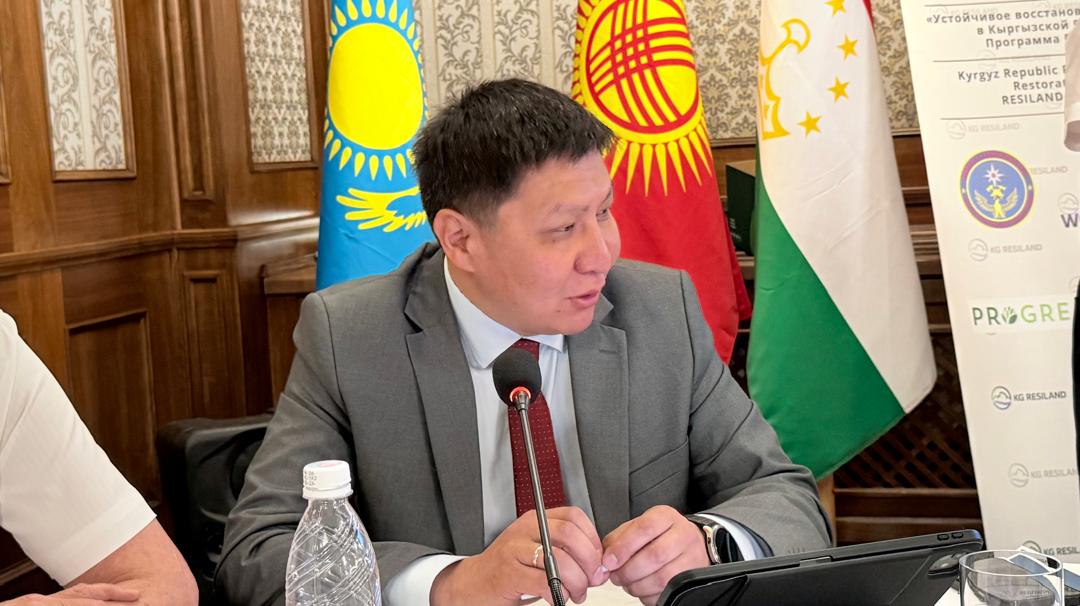
As part of the RESILAND Kyrgyzstan interview series, we present the second interview featuring Daurbek Sakyev, Director of Kyrgyzhydromet under the Ministry of Emergency Situations of the Kyrgyz Republic. He discusses the modernization of hydrometeorological monitoring, the introduction of advanced technologies, and how these efforts are improving the quality of monitoring and forecasting of natural hazards across the country.
Why is strengthening the hydrometeorological monitoring system strategically important for disaster risk reduction in Kyrgyzstan today?
Today, everyone can see that natural hazards are becoming increasingly unpredictable. Kyrgyzstan, like many countries around the world, is experiencing more frequent heavy rainfall, floods, mudflows, landslides, periods of extreme heat, and other hazardous events. Climate change is intensifying these processes, making timely access to accurate information more important than ever. The more accurate and timely the data, the greater the ability to assess risks in advance, prepare relevant agencies, and warn the public of potential threats.
RESILAND Kyrgyzstan is systematically strengthening the technical and institutional capacity of Kyrgyzhydromet. A key component of this effort is the provision of modern equipment and technology to improve observations and enhance hydrometeorological monitoring. Computers and field laptops have already been delivered to the Glaciology Department, along with a snowmobile to support fieldwork in remote high-mountain areas. At the same time, the project is modernizing the Observation Data Collection Center, improving data processing systems, and implementing additional measures to further strengthen hydrometeorological monitoring.
The main outcome of these investments is more accurate forecasting of hazardous natural processes. The earlier specialists receive reliable information on environmental changes, the more time authorities, emergency services, and communities have to prepare and respond.
Why are traditional observation methods no longer sufficient?
The volume of hydrometeorological information has increased dramatically. In the past, specialists primarily relied on data from individual observation stations. Today, they must simultaneously analyze information from multiple sources—including meteorological, hydrological, glaciological, and satellite observations—almost in real time.
As a result, digital technologies have become an integral part of modern hydrometeorological services. They automate data collection and processing, improve forecast accuracy, and significantly reduce the time required to generate information for decision-making.
What role does RESILAND Kyrgyzstan play in the modernization of Kyrgyzhydromet?
The support provided through RESILAND Kyrgyzstan extends well beyond the supply of equipment. An important component of the project focuses on improving the accuracy of measurements and the quality of hydrometeorological data.
One of the project's key priorities is preparing the Kyrgyzhydromet Verification and Calibration Laboratory for international accreditation under ISO/IEC 17025. This internationally recognized standard confirms that a laboratory has the equipment, methodologies, and qualified personnel required to produce accurate and reliable measurements.
Once accredited, the laboratory's calibration results will comply with international requirements. This will enable Kyrgyzhydromet to ensure the reliability of its own observation network and, in the future, provide calibration services to other government agencies and research institutions. As a result, both measurement accuracy and confidence in the data used for disaster risk management and decision-making will be strengthened.
The establishment of a national glacier and snow monitoring system is one of the project's key expected results. How will it work, and which organizations will participate?
Indeed, one of the most important objectives of RESILAND Kyrgyzstan is to prepare for the establishment and launch of a National Glacier and Snow Monitoring System. The initiative goes beyond equipping a single institution; it aims to establish an integrated mechanism that brings together observations, scientific research, data processing, and information exchange among relevant organizations.
Kyrgyzhydromet will play the leading role, working in close cooperation with the Department for Monitoring and Forecasting of Emergency Situations of the Ministry of Emergency Situations of the Kyrgyz Republic, the Tien Shan High Mountain Research Center, and the Institute of Water Problems and Hydropower of the National Academy of Sciences of the Kyrgyz Republic. Each institution contributes its own expertise, specialists, and monitoring capacities, which will be integrated into a unified information system.
The participating organizations are expected to conduct regular field observations of glaciers and snow cover, collect hydrometeorological data, carry out scientific analysis and modeling, and exchange information according to agreed procedures. The national system will be integrated into the Unified System for Comprehensive Monitoring and Forecasting of Emergency Situations, allowing the collected data to support both scientific research and practical decision-making for natural hazard risk assessment.
The project is currently in the preparatory phase. Terms of reference have already been approved for a functional, technical, and institutional assessment of the participating organizations, as well as for the preparation of a feasibility study for the National Glacier and Snow Monitoring System. The procurement process is now underway.
At the same time, the Kyrgyzhydromet Observation Data Collection Center is being modernized. An assessment of the existing system architecture has been completed, and a target model for the upgraded center has been developed. Preparations for the accreditation of the Verification and Calibration Laboratory are continuing, alongside the organization of specialized training programs for staff.
In parallel, the project is strengthening the technical capacity of participating institutions. Under RESILAND Kyrgyzstan, equipment required for field observations and scientific research is being procured. Kyrgyzhydromet has received off-road vehicles, a snowmobile, computers, and field laptops, while the Tien Shan High Mountain Research Center has received a vehicle and computer equipment to support field expeditions, data processing, and analysis.
The project's greatest value lies in bringing together previously fragmented observations, scientific research, and institutional expertise. Establishing an effective monitoring system requires much more than installing equipment—it depends on harmonized observation methodologies, continuous data exchange, clearly defined institutional responsibilities, and close cooperation among all participating organizations.
Why is disaster prevention becoming more effective than disaster response?
Responding to emergencies always requires substantial resources, including search and rescue operations and the reconstruction of roads, housing, engineering infrastructure, and essential public services. Moreover, some losses—particularly the loss of human life—cannot be reversed.
Prevention makes it possible to act earlier by identifying the most vulnerable areas, preparing emergency services, implementing protective measures, and informing communities in advance. Although natural hazards cannot always be prevented, their impacts can be significantly reduced.
This is why modern disaster risk management is increasingly based on preparedness rather than response. For the government, this means more efficient use of public resources. For emergency services, it enables action based on well-developed preparedness plans. For communities, it reduces risks to lives, health, and property.
The ultimate objective is not to eliminate natural hazards entirely—which is impossible—but to prevent hazardous events from escalating into large-scale disasters.
At the same time, even the most advanced technologies are effective only when the information they generate is interpreted and applied by qualified professionals. It is this combination of modern tools and professional expertise that enables timely identification of risks and informed decision-making to prevent emergencies.
Interview by Nazik Atambekova, Communications and Media Specialist, the RESILAND Kyrgyzstan Project
-----------------------------------------------------
The Kyrgyz Republic Resilient Landscape Restoration Project is part of the World Bank’s RESILAND CA+ program, aimed at strengthening landscape resilience across Central Asian countries. Similar national and regional activities are also being implemented in Tajikistan and Uzbekistan.
The Regional Environmental Centre for Central Asia (CAREC) implements the regional component of the Kyrgyz Republic Resilient Landscape Restoration Project.
Additional information:
Chinara Berbayeva - Deputy Director, Project Implementation Department under the Ministry of Emergency Situations of the Kyrgyz Republic / Project Manager, RESILAND Kyrgyzstan
Lyudmila Kiktenko - Deputy Team Leader, “The Kyrgyz Republic Resilient Landscape Restoration Project: Regional Component” Project, CAREC, lkiktenko@carececo.org